27
Mar
2010
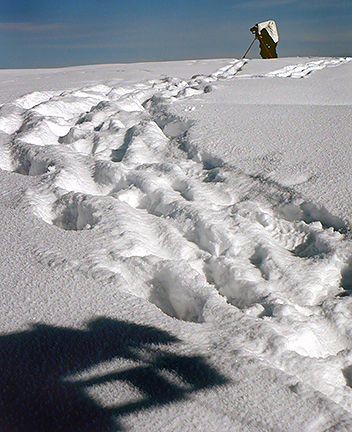 They say one image is worth a thousand words, or something like that. I have been asked numerous times to describe the making of some of my photographs. It is strange that I can remember a lot of the details of the moment. I can recall the feel of the place, and the excitement of being there in my mind’s eye. This coupled with my field notes detailing the date, time, and technical information, recreates a somewhat in depth story of the making of a photograph.
I have just started what I plan to be an ongoing project. I will take selected photographs and try my best to tell the story of how the completed interpretation was created. Hopefully there will be something of interest for everyone interested in all aspects of photography. Each installment will cover the making of one photograph, both artistically and technically.
I invite you to stop by the new “WHERE, WHEN & HOW: The Creative Interpretation“ area of our web site.
Enjoy,
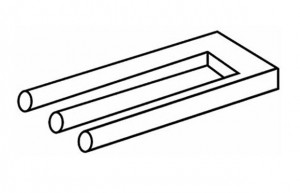 I keep harping on the idea that photography is about the photograph and not the equipment. Or, at least, that is the direction I prefer to take when it comes to the discussion of photography. Talking shop about the gear is the easy part. Talking about the photograph, and the makeup of an image is much more difficult.
The reason the hardware is much easier to discuss is because it is a real, tangible, thing. A piece of hardware you can pick up and hold it in your hand. It has a name and a specific function. You can learn to use a piece of equipment. Most everything about it is well defined and it works in a particular way.
What makes up art is something that is only a feeling. You either like what you see, or you don’t. Looking at some images triggers a feeling or memory that touches you deeply, but cannot be expressed with words. What is definitely appealing to one person is completely ignored by another. To express a great piece of art in words mostly detracts from its emotional content. You just can’t explain a great image.
I am much more interested in hearing how a person was attracted to something, which in turn led them to be motivated to make the photo, rather than the f-stop and shutter speed they used. There are those times when you just KNOW it is time to expose film. The question is, how do you know?
This is the hardest part of artistic photography. There are those that have attempted to explain what is pleasing to the eye by lowering themselves to a form of art speak. Stringing big words together does nothing but make a lot of squiggly lines on paper. Talking for the sake of talk and saying nothing, is what politicians base their careers on.
 We joined a group of local LF photographers last Saturday for a gathering and group shoot at a local park. I have to say that we had a great time. Met some new friends and saw some old ones also. It was a fun time for sure and I am glad we were able to attend. There were nineteen people there and most every kind of camera you could imagine from DSLRs to 8x10s. There was most every level of experience, from beginner to seasoned pro. The talk was lively and the interaction was priceless.
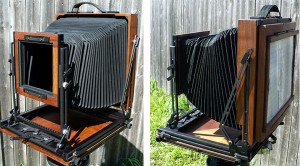
I hauled an 8×10 camera, set it up with several lenses, and let those that were interested look and ask questions. The thing is, I did not expose a single sheet of film. I really had no intention of making an exposure. I was there to enjoy the interaction with like-minded folks. I was there to talk shop. This was a gathering organized for the purpose of letting the interested see what a view camera is and how it works. This is the best way to learn whether you should look more seriously into LF, or not. Working with a view camera is not for everyone. I would never recommend to anyone that they run out and buy a big camera.
I took film, just in case something did materialize, but I never put a holder in the camera. I, for the most part, had no intention of making photographs. Certainly there were some visually interesting things going on in the park, but I was not in the mode of making images. I was in the Left Brain Mode of talking about cameras and how they work.
 I heard, or maybe read somewhere, that “Amateur photographers talk about equipment. . . Serious photographers talk about photographs!” Personally, I am much more interested in photographs than cameras. A camera is just a light-tight box that holds the lens and film.
Certainly it is important to have the proper tools in order to be successful at anything you attempt. Matters not whether you are building a bookcase, fixing a leaky kitchen faucet or making a photograph. But to obsess endlessly over your tool belt is not necessary. Think of it this way. You take your dream vacation to some really far away place you have always dreamed of visiting. Would you come back and tell everyone all of the details of where you visited, or would you go into excessive detail about the airplane that flew you there?
I defy anyone to look at a framed photograph hanging on the wall and tell me the camera, lens, film, or paper that was used. You would have to be a mind reader! Is the equipment necessary? Certainly! But equipment is only an apparatus necessary to reach an end. The camera is a tool, no more, nor no less, important than a wrench. All you really care about is that faucet in the kitchen stops dripping. Do you care about the name on that wrench?
What I care about is the finished photo on the wall. . . well. . . I have to admit that being out in the field searching for something to point the camera toward is also very important. But everything that goes on between those two moments is really of little interest to me, other than I having what I need to bridge the gap.
 We would like to thank the Fort Worth Camera Club for inviting us to speak to them about Large and Ultra Large Format film photography this past Thursday evening. We were warmly welcomed and presented a forty minute photo talk followed by many interesting and enthusiastic questions. We also had Susan’s vertical 8×20 camera on display along with a few original photos.