16
Oct
2014
 I am fascinated with all of the deeply technical discussions on some of the photography chat sites. Seems there are those that want to dissect every minute detail of the process. They want to over-analyze everything from camera focus, to lens sharpness, to even how a shutter works. We have those that argue about filter factors, meter calibration, and one instance of bellows extension being calculated to one eighth of a stop. All fine and dandy if you are into engineering. But my question is, what does this have to do with the finished print? That photo mounted and hanging on the wall either does it, or it fails. If it fails, is it some technical problem? If so, do you need to do some more math? If it is successful, does it matter what the technical details really entail?
 Every time I head into the darkroom I learn something new. I learn another way of thinking, working, creating or just being a photographer. Everyone knows that the first thrill in photography is just being there. You are out in some visually exciting environment, suffering from optical overload. You know that the vast majority of the film you expose will never be printed, but still you shoot away. I cannot count the number of times that the one I really had hopes for really flops when printed, and the one that was just a wild guess is a keeper. That is why you shoot. . . even if you are not really confident the results will be worthy of the film. You just never know, but if you do not make the exposure, you are guaranteed to have nothing.
Once you have all of the film processed and proofed, then begins the arduous task of selecting what you want to print. This is always a tedious and mostly unforgiving chore. Making a finished print is time consuming. I would say that either of us will put in ten to twelve hours in a typical printing session. And, generally we will produce, on a good day, four finished prints. Some days maybe less. That is why it is very important that the negative chosen needs to be well thought out, and you need to have some amount of confidence and a plan before you begin.
I don’t want to go into the darkroom and start haphazardly printing. I want to have some organization and a good idea of what I am going to be doing before I begin. Nothing is more frustrating than floundering around without a good starting point. It is bad for the head, it wastes time and materials. I would rather not print a day, spend that time getting prepared and then print the next day. I find that creativity is fleeting and if I am not in the mood, don’t even go there. Find something else to do till your mindset is correct. 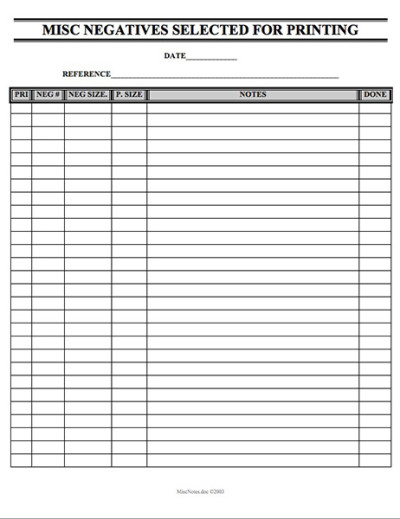
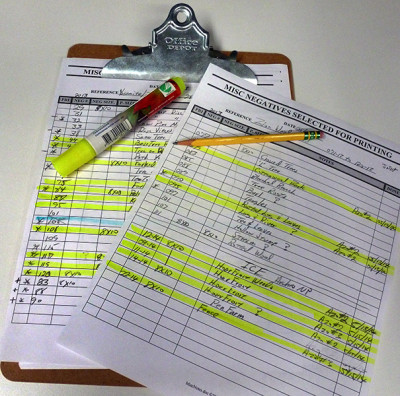
The process of negative selection begins by studying the proofs. We have worked up a sheet that we fill in with interesting photographs we would like to print. We call this sheet “MISC NEGATIVES SELECTED FOR PRINTING” and it is little more than a group of boxes to fill in with negative numbers, film size and notes. I ginned this up using a word processor years ago and we run off multiple copies and keep them on a clipboard in the darkroom.
As I said before, I keep refining my creative process. I have learned one thing that is even interesting to me. I have found that I print much better, have much greater success that is, if I concentrate on one particular type of photograph in a printing session. For me, at least, if I am printing say wood and leaves and having a good day, it is not a good idea to switch to printing running water or snow. It just doesn’t work well for me.
So, I have begun grouping my selected negatives into those that are of like content. An example would be; on our last trip we were in Yosemite NP, Zion NP and Arches NP. I did a lot of wood details in both Yosemite and Zion, so I have grouped all of the similar subject negatives onto one sheet. This way, I will only print those negatives in one, or several consecutive printing sessions. I have quite a few snow and ice negatives from Yosemite and Arches. Those will be grouped and printed in another session.
This may sound strange, but for me at least, I find that I print better when I get into one sequence of thought and keep the subject matter similar. It just works better for me. . . maybe it would work for you also?
Finding something worth exposing a sheet of film to is one thing. . . the next step is selecting the very best of your film for the finished print. Anything you can do to help will be a great asset to your art.
JB
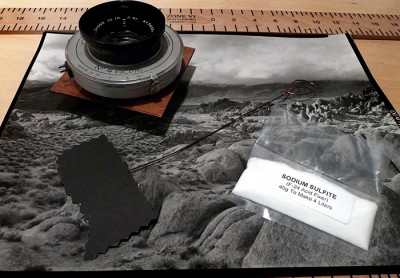 “. . . art lifts off from craft. Artist do things that craftsmen don’t know are possible.” -David Vestal-
The photographic artist is a blend of craftsman and artist. The finished print is the interpretation the photographer has chosen to display for consideration by the viewer. This finished print is seldom a true representation of what was actually in front of the camera at the moment of exposure. The photographer chooses, through the practice of craft, to present his, or her, interpretation of what they saw and felt at that exact moment in time.
The photographer must be a master of both art and craft. There must be a confidence in the practice of the craft that allows him, or her, to be able to convey what is seen within their mind’s eye into the finished print. The technology, limited by the mechanical and chemical boundaries, must be understood and used to the best advantage, or the image will fail miserably. The craft is fused with the artistry by understanding its limitations and properties, then using them to their best advantage to create the fine art print.
Honing one’s craft allows for the seamless integration of the inherent limitations of the medium with the artistic creativity within the artist. The craft should not be evident to the viewer. The use of craft solely for the sake of craft is annoying and obvious.
Learning and mastering the craft of photography is the easy part. Craft follows the exact rules of chemistry and physics. The art of photography is the hard part. There are no rules in art. The artistic statement is simply correct when it looks right. No amount of calculation nor measurement can be applied to art. So the logical approach is to first learn, then hone one’s craft, then use that skill to its greatest advantage to create an artistic statement. Simply put, in the creation of photographic art, the craft should be invisible.
JB
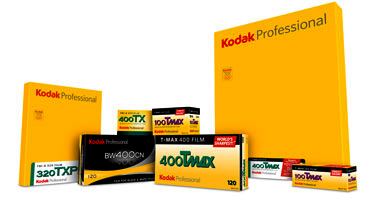
 I was recently reading about creativity, and I was captivated by a chapter titled, “THOUGHTS ON CREATIVITY” from the book “The Art of Photography: An Approach to Personal Expression” First Edition 1994, by Bruce Barnbaum p. 141. He touches on things I have seen but have never really understood.
Barnbaum says that in Western art creativity is all about originality, where Eastern, or as he calls it “primitive art” is more about traditional methods of the original masters. He talks of how the primitive artist works toward the quality and style of the ancient masters, and how any departure is not acceptable in their culture.
Barnbaum goes on to talk about how the primitive art mindset is not in fashion, nor acceptable in Western art. How working in the style of past masters is seen as, “redundant, hollow, and meaningless.” He talks of how even using past known techniques is looked upon as mere “copies” and are deeply frowned upon. He further says that working in the style of past masters is “a good learning experience” yet is not accepted as anything of worth by Western civilization.
I see this a lot in our Western culture. Someone takes a hand full of cow dung and throws it at a canvas and it immediately becomes a fresh new art form. Personally, all I see is BS. I have to admit that there are a lot of things I do not understand. Jazz is another thing I can’t comprehend. . . several people all playing something different at the same time is not music to me. But, that is my personal take and mine alone.
I love the work of the past masters of photography and I fully intend to continue to produce my work in that style. It is what I like, and if you don’t please yourself, you are not going to be convincing to anyone else. Guess I will kick back and put on some Pink Floyd and contemplate making some more primitive photographs. . . maybe some more of those redundant, hollow, and meaningless copies.
So, you can call me PRIMITIVE. . .
JB
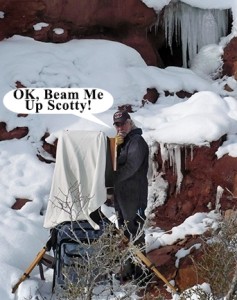 I was recently involved in a very serious discussion about photography. I was informed that the trend in photography today is for B&W prints to be light and airy. I was told that the deep blacks and brilliant whites I love so much are reminiscent of photography of the 1930’s and 1940’s and is not ‘in’ today. I was also informed that today’s trend is all about color images. I was given the impression that B&W is, in this so-called ‘modern’ world, sort of an ugly stepchild. At least, that was the impression I was given after a conversation with someone that is supposedly an ‘expert’ in the field.
Personally I have never been one to adhere to the current ‘trend’ or ‘fad’ nor do I give a rat’s rear about whatever is ‘in’ today. I have no interest in what is popular, nor in fashion. To be an artist you have to, first and foremost, be true to yourself. If you pander to the wishes of others, you will do little more than chase your tail trying to please everyone else. What is most important is to cater to your own vision. Truly meaningful images only occur when you have an internal connection to what you are photographing. If you are following some sort of fad, or the perceived wants of others, all you create are hollow nothings. This is what advertising photography is to me. I look at the images in magazines and TV commercials and all that is there for me is something visual to catch the eye for the purpose of selling something. My personal definition of salesmanship is, convincing someone to buy something they don’t want, don’t need, and can’t afford. I want nothing to do with this mindset. But I digress from my original thoughts.
I have a different view as to how I want to present my subject. I really wish I could find another planet to photograph. I want to show a world that is unseen by human eyes. This sort of thing being impossible, I have to resort to finding things that I can interpret in such a way as to portray them as otherworldly.
JB
 Guess it is time for one of my long rants. This time I am going to unload on computers. I will begin by saying I really hate computers. A computer is a machine and in being so, for me, it should perform a function. It should perform its assigned functions flawlessly and without me having to waste a lot of time coaxing it into working. I have been on this subject before and I think it is clear that about three years ago we set all of our PC-type boxes on the curb and went 100% Apple. This was the most intelligent move I have made in my life. Maintaining these machines has been a pleasure. I would estimate that I have spent 1/1000 of the time hassling with OS X as I did each year maintaining Windows. Never again!
Now this is where I start, that was just the background, in case you have not kept up with my rants. Once going Apple the only annoyance to me is the lack of support for OS X by some developers. It is an annoyance to have to run some form of Windows to gain access to several applications that are not supported. Fortunately for me, there are only about three applications that I have to hassle with. I have been able to somewhat use these apps by installing Windows XP using OS X BootCamp. They work, but not without some functions failing to perform. This has been a thorn in the side, but doable.
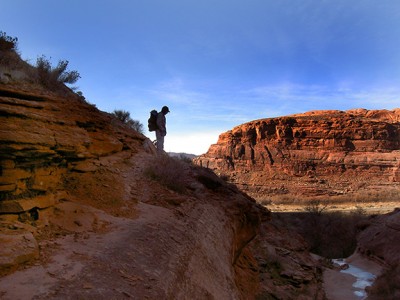
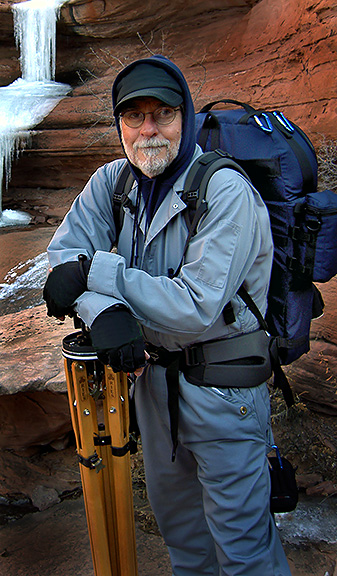 Brett Weston is credited with saying, “Anything more than 500 yards from the car just isn’t photogenic.” That is particularly true when you enter the world of Large and Ultra Large Format. I would even venture to say that distance shortens exponentially as the camera size increases. You could say that distance is inversely proportional to size. We live by these laws of physics and it is darn hard to get around them.
I have given this a lot of thought and have deduced that;
1. The camera folded size is determined by the film size
2. The camera weight is determined by design and materials
3. My back can only carry so much
So, it is pretty clear that item number one is fixed and there is not much you can do to make any format camera much smaller in size. Also, my back has its load limit and that I do not want to exceed. This leaves item number two as about the only place you can experiment.
It is understood that making any mechanical device lighter makes it less rigid. You have to sacrifice some rigidity for a reduction in weight and size. There is always someone that starts complaining about how some cameras are not rock solid when they grab one end and twist. They complain about the camera not being stable. The reality is, it is just a function of the design. I always say the same thing, the camera only has to be still while the shutter is open. The rest of the time, who cares? The camera is just a tool and should not be obsessed over. Choose what works best for you.
 Way back when I first started getting serious about photography I decided to buy a new 35mm camera. I did a lot of research and settled on three major brand names. The trouble was, I could not decide which best suited me. I knew that there would be no appreciable difference in the finished print. I challenge anyone to look at a framed print on the wall and tell me what brand of camera was used.
So, it all finally came down to making a decision. After some contemplation I decided to go to the local camera store and handle each camera. Actually I had done this several times, but what I was looking for as I neared my final decision, was which best fit my hands. My final choice was based on this one final criteria. I chose the camera that felt the most comfortable to me. Its controls were conveniently laid out and worked seamlessly. This is how I chose and I have never regretted that process.
Fast forward to today and little has changed with my thought process. I am always looking for what best fits my hand and my way of working. In any device design there are always trade offs. To gain one feature may require some sacrifice in another. Keep in mind that if you are going more than 500 yards with that LF or ULF camera, item number three above just may be the most important consideration.
JB
 I find it odd that when you tell someone you are a photographer they immediately assume you are the local Olan Mills studio operator. They either want a family portrait or have a daughter that is getting married and want to hire you. I guess there is a mass disconnect when it comes to the word photographer. Should I introduce myself as a Fine Art Photographer?
Maybe Fine Art Photographer is a little too stiff for an opener. Perhaps it would be better if I told people I am a photographic artist. That should throw them into a tailspin. Or should I start off by saying I am a photographer that does not work with people? I seem to face this dilemma at times and it is hard to convince some that I only shoot rocks and trees. Should I ask a person if they have some interesting rocks or trees in their back yard that they would like me to photograph? How about a nice 11×14 contact print of that old barn out on granddad’s old farm?
I am not out to offend anyone. I have no need to place myself above any portrait photographer, it is that I just don’t do people. It takes a special kind of person to coax out those really interesting images of a person. The knack of catching that expression just so. I’m no good at it and I will be the first to admit that to anyone.
I don’t like photographing anything that moves. I hate the wind. Seems every time I find something really interesting and I check and see the wind is absolutely calm. . . well. . . you know what happens. You get the camera all in place, pull the slide, get the shutter release in hand and there is just this little hint of a breath of moving air. Just enough to make some little feathery leaf or weed wiggle. I shoot with big cameras. An 8×10 is my every day shooter. I shoot with very small apertures and very long exposure times. If anything I have chosen to be perfectly sharp moves, I have just wasted a sheet of film. Depth of field is very scarce. How do you get someone to not move a muscle? Guess if I were photographing people I would be best suited to work with the dead. Would that suffice as an inanimate object?
So for those of you that are not familiar with Fine Art Photographers, the next time someone tells you they are a photographer, be sure to ask first if they do people. Don’t just assume that photographer translates to Olan Mills Portrait Studio.
JB