24
Sep
2012
 This is an interesting question that comes up all the time and seems to keep reoccurring. When will you give up film photography and move to digital, is something that is asked of me from time to time? My answer has been consistent since digital photography moved into the mainstream. Personally, my answer is, “I will give up photography completely if I have to go digital.” Plain and simple. . . I will never be able to create serious art with a computer.
My entire life has been spent in and around the electronics world. I began using a computer when the first Commodore Vic 20 hit the market. I had to learn computing in order to stay current in the engineering world. I see a computer as an engineering tool. It is not a toy, not a game machine, not a source of entertainment. It is a tool for designing complex machines and circuits. . . for navigating to the moon, and the stars. One thing is certain for me, it is not a device for creating my art.
I use a computer for work; I use it to write; I use it to access the Internet; I use it to communicate with others; I use it to update my BLOG; and I use it to host a web site. These to me are not artistic endeavors.
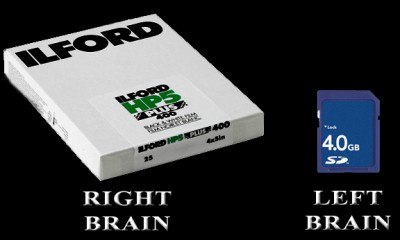
In my mind, a computer is not where I go to express myself visually. It is not where I go to create my art. In front of a monitor I am in a working mindset, mostly thinking in left brain mode. Creativity requires a catalyst. Only out in the field with my camera under the dark cloth, or in the darkroom does my mind really shift into right brain ‘creative’ mode. It is impossible for me to think in an artistic manner when clicking a mouse and looking at a monitor.
I know I have written about this before, but the same question keeps coming up, and my feeling about the subject does not change. This is how I work and how I think. The creation of art is a very personal thing and requires you think in a particular way. For me, I can only create when I am in the proper environment, and cyberspace is not the proper environment for me.
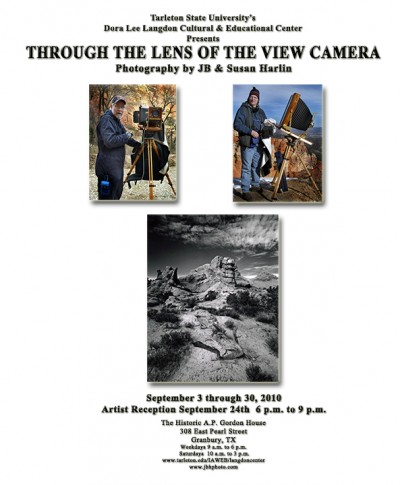 “THROUGH THE LENS OF THE VIEW CAMERA” is an essay originally published in the 2010-2011 “LANGDON REVIEW OF THE ARTS IN TEXAS” published by Tarleton State University’s Dora Lee Langdon Cultural and Educational Center in Granbury, Texas. This was in conjunction with an exhibition of our photography by the same title in 2010.
A PDF version of the essay is available for download in the ARTICLES area of our web site. Scroll to the bottom of the page and click on the link there, or go directly to the PDF HERE.
JB
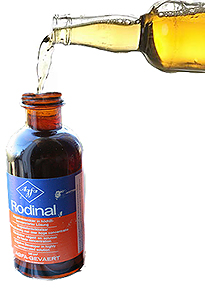 Even way back then I kept a notebook with all of my darkroom procedures laid out in a step-by-step fashion. This way I knew I would always do things exactly the same. I used the same graduates, arranged in the same order every time. Developing film is a one shot deal. Make a mistake and that is all she wrote. At this point in my progression with film and darkroom, I had become confident in my ability to develop film. The process had become the first step on the way to making prints.
My procedure for film was simple. I would line up my chemical containers in the correct order. Fill them with the proper liquids and adjust the temperature. Then I would head to my closet darkroom to load the film into the developing tank. I used a 16oz tank that held two reels and I usually did two rolls at a time. I loved the Rodinol because it came in a stock syrup and was mixed something like 1:200, if memory serves me correctly. I would measure the stock using two small syringes since it only took a few milliliters to make up the developer. I would lay the syringes, once loaded, next to the container marked developer which contained distilled water. I always have used presoak, so once the film was in the presoak, I would empty the syringes into the developer container and stir up the developer. Not much to it, simple and easy. Usually took me about forty five minutes from start to hanging up film to dry.
Now this one particular Saturday myself and a few friends went out and I shot two rolls of film that day. Later that evening we returned to my place for a few beers and by about 8:00 everyone headed home. I had this bright idea that if I processed the film from the day it would be dry and I could print it Sunday. Nothing to it, just get out the notebook, measure and slosh. . . processed film!
There was nothing very special about this film run, except the slight fog in my head from the beers and maybe a little to much sun. Everything went as usual. Once the film was washed I unrolled the first strip to find it completely clear end to end. The second roll was the same. What the @#$%^*? My first thought was the camera quit working. As I sat there perplexed I looked at my processing line and what do you think I saw? There next to the empty container for the developer lay my two syringes with the stock Rodinol still in them. I had failed to mix the developer. I learned right there that plain distilled water will not develop film. I also immediately enacted a strict rule in the darkroom; NEVER MIX RODINOL AND BEER!
JB
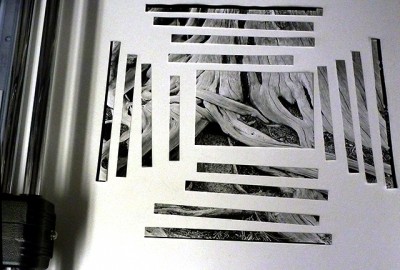 Those that dictate hard and fast, unwavering, rules for the creation of art usually are the vane, egotistical, self-centered types that are full of their own over-inflated view of their importance and try to tell you that cropping is an unforgivable sin. I say. . . Not True!
No one has the authority, nor the right, to tell you what, nor how, to create your art. Cropping is a personal decision, and can only be justified by you as an individual. If cropping helps any particular photograph, then it is no sin to proceed to crop away.
Cropping is best done in the camera at the time you make the negative, but it is not always possible. There will always be those instances that appropriate framing is just not possible in the field. Never pass up an opportunity just because the perfect image does not exactly fit the film. Keep cropping as an option. Do not dismiss anything that will help. 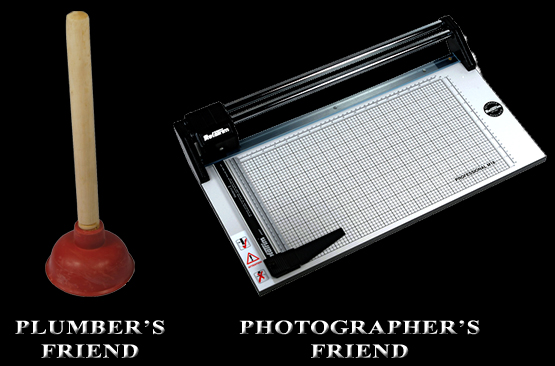
During the printing process look carefully at your first work print and determine if the image is strong from corner to corner. Use cropping L’s to mask questionable edges of the image and determine if lopping off some of the image will strengthen it. If you are enlarging you can reset the easel and the print size. If you are contact printing, a rotary trimmer is your best friend. The choice is totally yours. Do not be a slave to others opinions. There are no rules. The decision is so eloquently expressed by Bob Segar: “What to leave in, what to leave out. . .”
If cropping does not improve the photograph, maybe it is a good idea to find another image that will be more expressive. If you do hit a brick wall with a photograph, save your work and put it aside for later. There are few negatives of questionable substance that are worth killing yourself in order to print. You are usually better off to concentrate on those that are not a struggle to print.
It is easier on you and more productive, and less frustrating, to make negatives that are well seen and easy to print. A mastery of craft will make everything work more smoothly, but never let anyone tell you that you should not, can not, crop your photograph. Just don’t go there! Cropping can be your best friend.
JB

 “He tried to impress upon me that, though a camera is nothing but a tool, it can be (therefore it must be) used for a higher purpose than the meaningless transference of already visible information onto a sheet of paper. Because camera could describe a worker’s vision of his world, like a cello or a paintbrush, or granite block, camera held the capacity for art.”.
If you want to become a photographic artist the first goal is to become an accomplished master of the equipment. But, how do you get there from here? It starts with ambition and drive. Like any skill, you will only learn, and become a master, if you are dedicated. The mechanics of photography are not difficult to learn. It does take time and determination to get there, but it is not an unachievable task. You just have to have the desire and drive to work through the process of learning how best to use the tools.
 In my last post here titled “ORIGINALLY POSTED ON OUR OLD BLOG; Saturday, January 17, 2009; WHERE HAVE ALL THE PHOTOGRAPHY CLUBS GONE?” I tried to make the point that the failure to promote and teach ultimately leads to the loss of knowledge and processes that need to be preserved. In that post I was particularly hard on the photography clubs and their failure to promote and maintain the many facets of the art of photography. Photography clubs have become, for the most part, computer clubs. They ignore the other facets of the craft and even tout the lie that digital is all there is in the entire universe. This to me short changes everyone and leads to a loss of other beautiful and useful photographic processes. It also leads to pure ignorance among those that are interested in entering into the art form.
Below is a review sent to me from a photographer friend of a Nikon F6 camera that someone purchased through Amazon. At first this was funny to me, then I thought it was a joke, and finally the hard and sad truth began to sink in. This represents the sad state of affairs today. Read this review;
—————————————————–
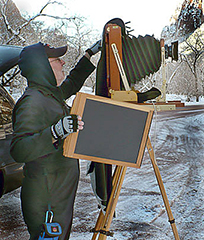
JB Harlin With 11×14 Camera
To answer that question, they have turned into Computer Clubs! Why? I really do not know why, but I have an idea.
People in general are consumer driven by what the large manufacturers say and do. Certain large, should I say behemoth, manufacturers have taken the initiative to try and influence the photographic market place. Corporate bean counters are forever trying to enhance the bottom line. These so called Harvard MBA’s have little to no experience in reality, they just look to their book learning and spread sheets for bigger, better, faster. They are paid to find pie-in-the-sky schemes that look good for the bottom line. They know little about the product nor its users. And, they really don’t care about anything beyond the quarterly report to the board and share holders. This mindset has filtered into the film photography industry. They don’t care about their product nor their customers beyond what they can get from either or both. Hence the battle cry “Film Is Dead” has gone out through the photography world because someone thinks that is where they can make the most money. And, people, sadly most people, follow like sheep. Repeating the call and believing it is true.
How many times have I been asked, “where do you get film for that camera?” This gets really old in a hurry, but the reality is, people are just misinformed. Way too much TV, radio, magazine ads, billboards, newspapers, Internet, etc, for anyone’s good. We, as a society, are pounded day and night with endless advertising. And, sadly, we believe it! “We couldn’t say it on TV if is wasn’t true” is something I hear on some infomercial. Remember, advertisers will tell you anything to get your money!
Posted by JB and Susan Harlin at 1:53 PM Saturday, January 17, 2009
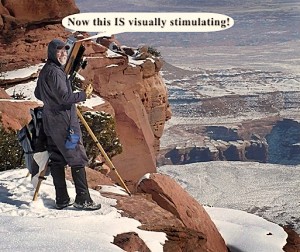 I have struggled for years to understand the concept of what is visually stimulating. Just exactly what does it take to strike a nerve that leads to the successful completion of an expressive photograph? Specifically, why is it that I cannot easily find something in my immediate environment that I find worthy of photographing? There was a time when I really thought there was something wrong with my perception of my surroundings. Edward Weston said something to the effect that, you should be able to look down at your feet and find something interesting to photograph. Doesn’t always work for me.
The trouble is, I have a difficult time finding anything within my local surroundings that excites me very much. Some of this has to do with the fact that I live on a flat coastal plane at 600 feet above sea level and what I like the most is mountains and snow. I just can’t seem to find barb wire fences to the horizon, hay rolls, or wind mills that interesting.
I used to think this was only a personal mental issue that I alone suffered from, and that I was in some way creatively impaired. I thought that all I needed to do was find some magic somewhere that would allow me to visually connect to what I see every day. There were those times that I was able to find visual stimulation. Such as dense fog, or really interesting clouds, or maybe a rare snow storm. But most of the time I found that I was forcing myself to just get out and that what I created was not something I really cared for. So, why bother?
As I began to associate with other photographers, many living in other areas of the country, what I found was surprising. I met and talked with people that live in some of what I feel are the most visually stimulating places on the earth. To my dismay some of them have no interest whatsoever in even visiting, let alone photographing what I would give near anything to have unlimited access to. I have talked to people that have grown up within a few hours drive of these places and have never visited, let alone ever had even considered to take a look, let alone make a serious photograph of what lay literally in their back yard.
I began to realize that I was not alone when it came to finding inspiration and visual excitement within my immediate environment. I began to think more in terms that this is a normal ‘thing’. . . a ‘syndrome’. . . a ‘phobia’. . . or whatever, that many other suffer from, or in some way deal with, also.
1 “The Thing Itself; The fundamental principle of photography” First published in Newsletter, Daytona Beach Community College, 1988
http://www.billjayonphotography.com