10
Jan
2011
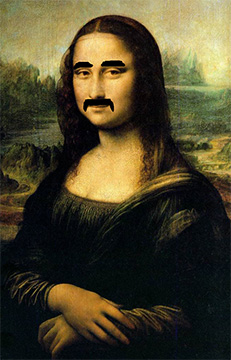 I really like hearing the story of the origin of anything. For all of my life I have heard the term ‘masterpiece’ and always thought it was a modern term as in definition #1, #2, and #3 below.
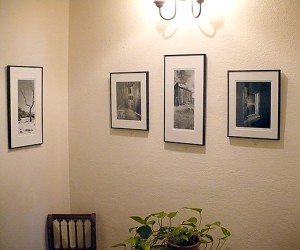 We recently had an interesting conversation with a local gallery curator and found that we unanimously agreed on one thing. Most art and all photography should be displayed in the most simple manner possible. Nothing is more distracting, and annoying, than an obnoxious presentation. Large, gaudy, frames with funky colored mats are just plain ugly. Our approach is to keep the presentation simple. The framing and mat should be completely transparent. It should only exist to isolate and protect the photograph. If you notice the frame and mat before you see the image, it is just not right. The KISS Principle (Keep It Simple Stupid) is the only way to display photographic art.
For us, you will not find any of our prints mounted and matted with anything other than pure white, acid free mat board. If we frame for exhibition, we use narrow black aluminum frames. The only other frame we would consider would be narrow natural finish maple. Our first choice for glazing would be glass, with acrylic as the second choice. That is it. Anything else is just plain gaudy and unnecessary.
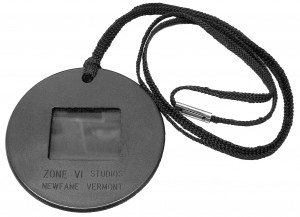
Zone VI 4×5 Viewing Filter
So, what is a B&W viewing filter? In reality it is a Wratten #90 monochromatic filter. The gel version of these filters are available from the usual photographic suppliers. They are a gelatin filter and fragile. Several companies manufacture monochromatic viewing filters. Tiffin has a version for B&W, but we prefer the Zone VI filter. It is rugged, mine is over 15 years old and still going strong. The fragile filter is mounted between glass and encapsulated in a round molded plastic enclosure. The filter comes with a cord so it can hang around your neck ready for use at any time.
So, what does the B&W filter really do? What it does not do is turn a scene to B&W. The filter shows you the approximate tonal relationship between different areas of a scene as recorded by B&W film. It will show you if there are any mergers of tone within a scene. For example, the filter will show you if a building will tonally merge with the sky, thus indicating the use of a filter to darken the sky for separation. It will also give you a good idea of how different colors will look in B&W. I have found that nice little green moss on a tree trunk will merge with the bark and disappear. The viewing filter will show you this with just a glance. Once you get used to using this handy, yet simple little device, you will not want to be without it.
The Zone VI version also serves as a framing device. The 4×5 version has the same proportions as a 4×5 or 8×10 negative. By learning to hold the filter at the correct distance from your eye, you will soon be able to approximate what focal length lens is required on your camera for a specific framing.
 What is in a name? Interesting question for sure! There are times that a name has little meaning, other times it can be the key to an empire. Companies spend untold sums of money in the creation of a name for their products. Their chosen names are trademarked and protected by law. Some names are household words and are part of our everyday life. There are times when a name is extremely important.
There is a revolution brewing in the world of photographic art. The digital vs. analog debate is raging on, and at times is near a war rather than a debate. There are people aligned on both sides and most have made their choice. I can say without hesitation that I have made my decision and I plan to stay the course. It matters not what your preference may be as to the photographic medium you choose. The choice is a very personal and serious decision. You need to be comfortable with your selection and dedicated to its use.
There is this grand misnomer that digital is a replacement for film. There was even a wide spread rumor that film was dead. This is nothing but a pure deception. . . little more than a marketing ploy by people in the photo industry that do not have a clue as to what photographic art is about. Do not buy into the farce that film is dead.
But I digress from my original topic. . . now back to the question at hand. What we need is to be more specific about photographic art. Gone are the days that the word photograph was assumed to mean a procedure based on film and the wet process. Photography has branched out into a more complex art form. Digital photography is a new art form, not a replacement. It is a new way of making images. Because of this new medium there is a lot of confusion pertaining to the process. Each medium has its own peculiarities, strengths, and weaknesses. . . each needs a name. We need to be more specific in the description of the imaging process. After much thought, I have defined three areas that encompass photography today.
This process has numerous subcategories which are all based on an imaging process that uses film, a wet darkroom, and chemical processes from start to finish. Simply, the way photographs were made before the introduction of digital imaging. This also includes the numerous alternative processes that are still practiced today. This is my choice for the creation of all of my photographs, thus for me using film and the 100% wet darkroom process, my finished print on gelatin silver paper, would be identified as a Traditional Silver Gelatin Photograph.
 This is my choice and has absolutely nothing to do with anything other than it is what I feel correctly reflects the different types of photography. If you have chosen to be a digital photographer and work in that medium, why be ashamed of it? Same if your work is produced by the hybrid method. Why not be proud enough of your chosen medium to accurately define it and not hide behind the general, and now somewhat vague, idiom of Photography? Just keep in mind that none of these three categories are the same and none is a replacement for any of the others. Each is simply its own art form and they all fall under the general category of Photography.
 Back in February 2009 I posted an entry titled “WHO USES PYRO?” and ended it with this statement, “I have about reached a conclusion as to which formula best suits what we do. . . and. . . I may just write about what I found at a later date. . .”
One thing I can say for certain is that for us, and let me be very clear about this, I repeat, FOR US and the way we work, most any staining developer out performs any non-staining developer we have used. It was just a matter of finding the right developer that suited us and one that would allow us to produce prints that have the presence and feel that best suits our vision.
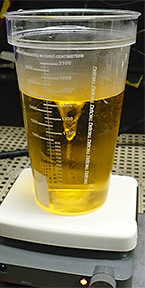
After working with several of the more popular staining film developer formulas we have finally chosen our favorite. There was a lot of research and comparisons, followed up with field testing in order to ascertain what best fit our needs. I defined the main criteria and judged each developer on how well each performed in each area. Here is a short list of the main points:
• the formula had to be published
• we considered how we work
• what we expect from the negative and developer combination
• ease of use
• consistency of the developed film
• stability of the developer formula
• stain color
• general stain and stain density
• the look, feel, and overall print quality
• last, but not least, the cost
I prefer to always be able to mix my own chemicals from scratch. This became my first issue, since I do not want to depend on the availability of the developer from an outside source. I am a strong believer in vertical integration. Also, if I want, I can modify the formula, and I always know who to blame if something goes wrong.
One thing I have learned is that Pyrogallol is cranky. Nearly all of the formulas we tried that were based on Pyrogallol, at one time or another, under certain circumstances, gave inconsistent and sometimes unpredictable results. The problems could have been caused by any number of variables. We tray process all sheet film using the shuffle method. Some of the Pyrogallol formulas showed signs of aerial oxidation in the tray at the end of the developing cycle, while others did not. The biggest problem was that every Pyrogallol formula we tried, performed erratically and at one time or another, produced an occasional unevenly developed negative. One formula was especially sensitive to wash time. The longer you left the film in the washer, the more the general stain increased and the film went from a near neutral color to deep green. Never did understand what caused that. I am sure it was something that I did, but I do not like to have to deal with something that is that sensitive to slight variations of process.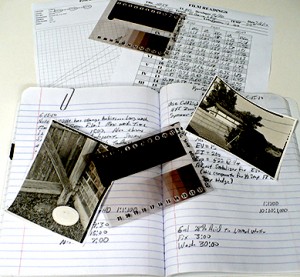
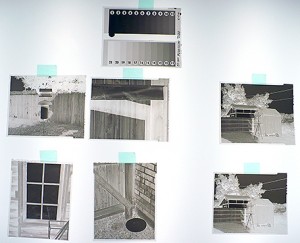 One thing I did learn was that Pyrocatechin is a much more stable and user friendly developing agent. The Pyrocatechin formulas showed little to no aerial oxidation in the tray after a processing run. No matter what I did, the negatives have not shown any uneven development or any other problems. I prefer to have the confidence that even if something is a little different during processing, it will not cause inconsistent results with the finished negative. In other words, I like to have a little wiggle room.
One other quick observation has to do with the general stain color. I know there has been a lot of discussion about the stain color and again this is what we have found to work best for us. Through our experimentation we quickly learned that green negatives do not work well for us. We print on numerous different papers, and use both graded and variable contrast materials. There is no one magic paper! The right paper is the one that works for any particular negative you are printing. We have found, that for us, the more neutral to brown stained negatives work the best. That is just us. . . if you find otherwise, then use what works for you.
With all of that behind us and a notebook full of test data, I can say it is time to stop the experimenting and get on with what is important, creating photographs. We have now chosen our favorite standard film developer. Pyrocat HD by Sandy King has proven to be the best choice for the way we work. What else can I say. It works. . . works consistently. . . and meets all of our expectations.
I would like to thank Sandy King for all of the research and work he has put into this formula. If you are not familiar with Pyro developers and Pyrocat HD, click HERE to learn more.
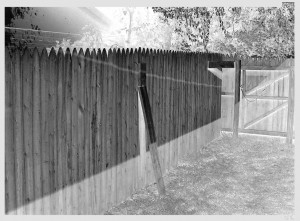 Contrary to popular belief boys and girls, FILM IS NOT DEAD! And I have the proof to boot! One question that everyone has is, where do you get film for that camera? Or, even more disturbing, I thought they didn’t make film any more? Then, where do you get film processed? And finally the most frustrating of all, why would you want to mess with film?
Well, I am not going to address all of this, but I am going to shout from the roof tops again, FILM IS NOT DEAD! Something great has just happened and I am jumping up and down with excitement. Keith Canham, owner of KB Canham Cameras has just announced at Photokina this year that he is now partnered with Kodak to coordinate orders for LF and ULF film. Keith will now take orders for any current Kodak film, in any size! Let me say this again. . . any current Kodak film, in any size!
Plus, just to reinforce the idea that film is not dead, Kodak also announced a new color film. Think about this now. . . Kodak is still developing new film emulsions. They are still doing R&D and improving film! Need I say this again. . . FILM IS NOT DEAD! Here is a portion of the announcement;
 Years ago I found myself with access to a violin. I love the sound of a violin. There is something about a beautiful, single note when played by an accomplished violinist. There is a richness. . . a richness of sound. . . a deep resonance, with harmonious overtones in just a single note. I thought this can’t be that hard, you just draw the bow across the string and out comes the sound. Not quite for me though. I even resorted to reading a little in the beginner’s book on bow technique. But, no matter how hard I tried, it always sounded like someone dragging a heavy metal chair across a concrete floor. It was immediately apparent that I really did not want to learn the technique that bad. That was the end of my effort with the violin.
So, what does this have to do with photography you ask? Well, maybe nothing. . . maybe a lot. . . depends on your point of view and interest. No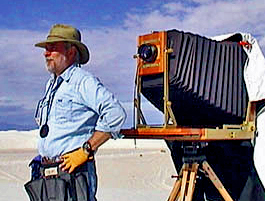 matter what the commercial says, there is no easy, quick way to anything. . . and. . . believe it or not, you can never have it all, and there is no free lunch! Life is about choices. If you spread yourself too thin, you will never achieve anything. If you sort of think you are interested in LF or ULF photography, you are setting yourself up for failure. LF, and especially ULF, is not easy, not foolproof, and is hard work. There are many pitfalls that will frustrate and test your patience. If it can go wrong, it will! You have to really want to work with LF or ULF. You have to be able to find your way through all of the little things that will ruin your every effort. If you are determined, and if you really have the desire, you can, and will master the craft. Persistence and patience will pay off in the long run. But, if you are looking for instant gratification, find another interest.
I would never recommend that anyone jump into LF or ULF photography. It is just not for the faint of heart. . . those that are not dedicated enough to invest in the time it takes to master the process are doomed to failure. Sort of like playing the violin. I am really glad I didn’t buy a violin just to find out I actually didn’t want to learn to play the thing. If you only have a casual interest, you just may be better off letting someone else do the fiddlin’ around.
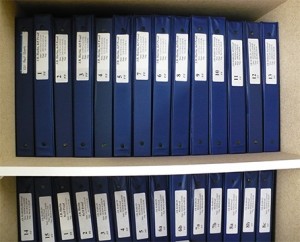 In the last entry I talked about making film notes in the field. That is the first step in the process of record keeping. I didn’t mention the last step which is negative storage. Each negative is marked on one edge with a unique number, then inserted into a clear sleeve then into an archival envelope. Each envelope has the negative number written on the upper edge. The envelopes are then placed into archival boxes, which are labeled with the contents. Also, the smaller film is proofed on our standard paper. These proof sheets are punched, and filed in binders. That pretty much sums up the negative end of the process.
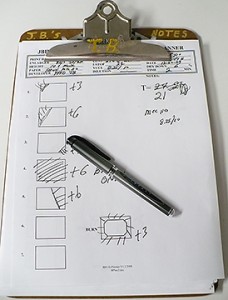 we use to record the process. We make our own print planner sheets using the computer to document every step in the darkroom. Our print planner sheets have spaces to record all pertinent information for the creation of a finished print. It includes the negative number and date, along with the print date, printing paper, developer, enlarger settings and such. The print planner sheet also has a series of boxes to record exposure manipulations. . . burning and dodging. That way if we ever need to go back and reprint, we have a record of exactly how we made the first prints. These sheets are filed in a three ring binder and labeled for future reference if needed.
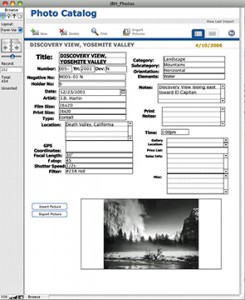 We also keep a computer database which contains our catalog of available photographs. This database contains all of the information from the film and printing notes. The master catalog database also contains information on the number of prints available, price, and exhibition information.
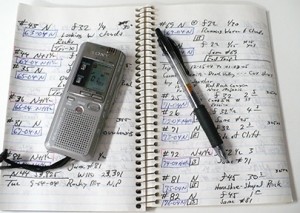 I have written quite a bit about LF and ULF photography here on the jbhphoto BLOG since we started back in January of 2009. A lot of it is my rambling about this or that, and sometimes I tend to repeat myself. Oh well, must be old age??? One thing that I do not remember writing about is keeping notes. We are both meticulous about keeping records of our travels and detailed notes on the film we shoot.
We do several things when we go out on an extended trip. One is to make a lot of snapshots. They are an excellent way to keep track of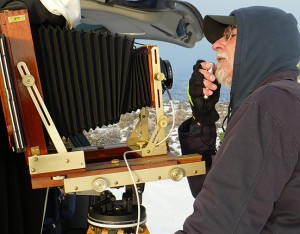 the places we visit and are used to plan future trips and serve as a visual reminder of the places and things we discover. We also keep a daily diary/travel log of what, when, and where we were on a particular day. I have to admit that Susan is better at the diary than me, but at the end of every day before we drop off to la-la land, we try to type a few paragraphs. We keep this on a laptop computer and entries continue till the trip is over. It is a great resource, along with the snapshots, later when trying to come up with exactly what happened on any particular adventure.
But, the most important notes are those that pertain to the film we shoot. I experimented for some time when I first started shooting sheet film and eventually came up with a record keeping scheme that works. We have both used this method for many years and it has given us detailed records that, when needed, are invaluable.
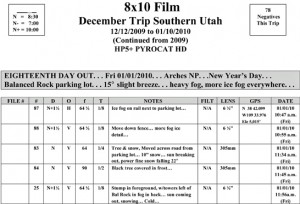 Originally we transcribed each film audio entry into a notebook by hand, but starting about three yeas ago we began typing this information into a computerized form. This form has spaces for Negative Number, Film Holder Number, Development, Image Orientation, f Stop, Shutter Speed, Notes, Filter, Lens, GPS and Date and Time.
This is a somewhat complex way of keeping film data, but it has proven to be well worth the effort, especially when you need to recall the what, when, or how of a particular photo that you made years back. I can go to my film notes and tell you most anything about a particular negative, including the weather.
Keeping notes is also a way to track mistakes. If a particular negative did not turn out as expected, you have all of the information that can provide a clue as to what went wrong. I also record information on my audio entries about location, the light, temperature and anything else that might affect the image, or the photographer. Your notes can be a lifeline to help you track problems.
Detailed records of each sheet of film are not hard to keep up with if you are diligent and keep the process current. Next time I will talk a little about keeping notes in the darkroom. . . and. . . yes, we also keep pretty detailed records of the prints we make.