Commentary

UTAH DECEMBER 2008

VIEW CAMERAIn a previous post I talked about issues that seem to crop up when shooting sheet film. When I refer to issues, I am talking about things you can do unintentionally that may or may not ruin a particular negative. See my previous post “WHAT CAN GO WRONG?” for a better idea of the issues.

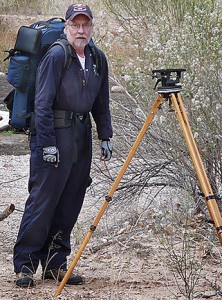
We spent the entire month of December 2008 in Utah. This was one of our typical photo trips and we were there to make photographs. This trip we brought back 276 sheets of film in four formats ranging from 4×10 to 11×14.

Mistakes? Who makes mistakes? Issues? What Issues? Of the film that I exposed, I had 136 sheets in two sizes. Of those sheets, there were three sheets that I ruined, due to just plain dumb mistakes.

At lot of my mistakes come near the end of the day, when I am tired. Lugging 40-50 pounds all day in the snow will wear you down. I do make mistakes. No matter how hard I try, I seem to always screw up a few sheets of film. The biggest one this trip you ask? I double exposed an absolutely great photo of glowing cottonwood trees. I now have this strange 8×10 negative with two large trees. . . at right angles! Yes, the first exposure was a horizontal, the second was vertical. Oh well. I did make several other negatives of the same tree, so not all is lost. And as I said in my previous post, I had a few choice words!
JB

Posted by JB Harlin in Commentary, Photography

YOUR DARKROOM

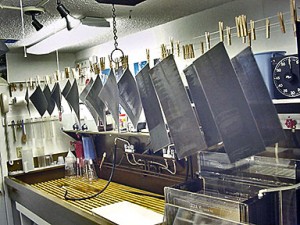
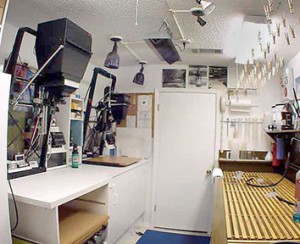
DARKROOMEveryone that has dabbled with their own film and print processing has been forced to build some sort of minimal darkroom. It is amazing to hear all of the darkroom stories from those that have been there and done that. But the truth is, there are many serious photographers, that have created amazing bodies of work with only the most basic darkrooms.

My first darkroom was in a small closet in a small apartment. I bought a garment rack and my clothes hung behind the bedroom door. A working darkroom does not have to look good. . . it just has to work good. You can load film, expose, and process paper in most any area that can be made lightproof. Once loaded into the tank, film can be processed on the bathroom vanity or kitchen counter. Paper, once processed, can be washed wherever you can set up a washer.DARKROOM

When you start out you may move. No telling how many times you may move before you finally settle in one place. An elaborate and expensive darkroom is nice, but if you relocate, you leave most of it behind. If you rent you have to be creative. I have moved numerous times and the more you move, the better you get at setting up some area as a darkroom.

You don’t need running water, it is nice, but not necessary. You can wash prints in the spare bathroom shower, or tub. One time I had a dry sink made from an old door, with sides screwed to it and painted with enamel paint. I later modified this with a drain, but it ran into a five gallon bucket. This was set up in a spare bedroom, with black plastic over the window. I washed prints in a print washer on the floor of the shower.

You can improvise as required when it comes to the setup. Buy a really good enlarger, with a good lens. The rest is up to you and your budget. A few trays, storage bottles, daylight film tank and chemicals and you are ready to get started. The fact is, you do not need an expensive, nor elaborate, darkroom to make seriously significant prints. Learn to make the most of what is available and put your money and effort into making fine prints. Don’t let the lack of a fully equipped darkroom come between you and your creativity. You can build that dream darkroom later.

JB

Posted by JB Harlin in Commentary, Darkroom, Photography

IS THAT AN OLD CAMERA?

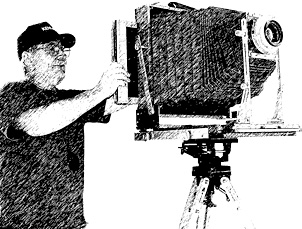
How many times have I been asked, “is that an old camera?” I usually have to explain that no, it is actually a modern version of an old camera. Seldom am I asked why I would use something like an old bellows-type camera. But I get the feeling that there are those that would like to ask why.

Am I the only one that believes that simplicity has its place? For me, it really has its place when it comes to my art form. When I get out in the field, I want the equipment to become transparent in its function. And, the best way I have found to achieve this transparency is through simplicity.

I have started a list of things that I like about using a view camera. It goes something like this:

No batteries
No multi-function buttons
No multi-layered menus
No planned obsolescence
No little tiny buttons to locate
Nothing new to learn
Nothing to upgrade

I am sure with a little more time I could think of more, but I am sure you get the idea. I love the feel of a view camera. I love the feel of a view camera on a very large, heavy, wooden tripod. I love to climb under the dark cloth and just look at the ground glass. I love the fact that the image is upside down. Nothing will do more to improve your compositions than a flipped image. I like the slow pace of the view camera. I love spending an afternoon just exposing two sheets of film of one subject. Waiting for the light. Waiting for things to come together just right. I like the idea of having only one chance to make the image. I love to just stand next to the camera all set up and ready to click the shutter and just wait. I hate to be rushed. I hate to be pressured. And if things don’t work out, I can just put the camera up and head home. Nothing gained, nothing lost. There are times when just being out there with the camera is the best part of the entire experience. It is great when I bring home a really nice image, but not always necessary.

So. . . does anyone reading this believe I am a view camera advocate? Yep, that pretty much describes me. I would never even consider making a serious photograph with anything but a view camera loaded with B&W film. Just me, but I love what I do, and now you know why.

JB

Posted by JB Harlin in Commentary, Film, Photography

IS THAT A FENDER THIN?

Unless you play guitar, you probably have never heard of a Fender Thin. If you are not a guitar connoisseur, it is a guitar pick. Now why on earth would someone that shoots LF and ULF be interested in a guitar pick, you ask?

Ever try to unload a sheet film holder while wearing Nitrile gloves? Or ever had a sheet of film that has a slight rearward curl. Then you know how difficult it is sometimes to get your finger under the sheet to remove it from the film holder. Now do you see the value of a thin guitar pick?

I keep a small container of thin guitar picks near the back of the enlarger baseboard where I normally unload film. I can locate my stash of picks in the dark and they are invaluable sometimes to get that stubborn sheet of film coaxed out of the film holder without excessive handling or damage. A thin guitar pick can easily be slipped under the film to allow you to get your finger under the film edge.

The next time you see a music store, stop in and purchase a few thin guitar picks. They could save you a lot of frustration. Who knows, you might want to take up the guitar!

Finally, just for the record, I really don’t use a Fender Thin. I prefer the super thin nylon 0.46mm pick sold under the Jim Dunlop name. In case anyone is really interested.

JB

Posted by JB Harlin in Commentary, Film, Photography

WHAT CAN GO WRONG?

Seems as you shoot larger and larger formats, you find more and more mistakes to make. Anyone that has spent much time with a view camera knows all of those common mistakes you can make. No matter how experienced you are, and what you do to create a routine, something happens every now and then.

Just to name a few things that will come up to ruin your film; you pull the dark slide without closing the lens; you forget to set the aperture; you forget to pull the dark slide; you forget to cock the shutter, and the noise of the running water is so loud you cannot hear if the shutter fired; you fail to get the film holder properly seated in the camera back; there is dust on the film, always right in a nice even area of sky; strange light leaks; lens flare; camera flare; you kick the tripod after taking forever to get the image framed just right; and don’t forget double exposure. This can go on and on. Any number of other things, can and will happen, that are just right to ruin that great photograph.

These things never happened to you? Bet it has, even if you are not willing to admit it. All of the above, and many more, have certainly happened to me. The only way to lessen mistakes is to establish a routine. Do everything in the same order and double check as you go. But, even then, every now and again, something will get you. Just learn to live with it. Mistakes are one thing we all share in common. It is just part of being human. But I still reserve the right to express a few choice words when I screw up a good image.

JB

Posted by JB Harlin in Commentary, Photography

OUR REVISED WEB SITE IS UP!

Finally!!!. . . Our updated web site is now up and hopefully running. We have added new snapshots and we both have completely reworked our gallery pages. Please take a moment to browse through. . . and. . . if you find something not working, drop us a line???

As always, thanks for your support,

JB & Susan
jbhphoto.com

Posted by JB Harlin in Commentary

Ansel and Me. . .

There is one thing I can say beyond a doubt that I share with Ansel Adams. We share the same birthday, though he was near five decades before me. My only real regret when I think of Ansel is that I never met the man. But, every year I salute his birthday, maybe only because it is one thing we share. Happy Birthday Ansel!

JB

Posted by JB Harlin in Commentary

TEN YEARS ON THE AIR


WEB SITE

jbhphoto.com c 1999

We are going through the dreaded web site update. This happens every year at this time and we dread it. This year we are changing how our galleries will look. They are not ready yet, but come back and check often.

The thing that struck me while working on the site was the fact that we have had a web site for ten years now! Hard to believe how it has changed over the years. The first site was quite simplistic and small compared to today.

We would like to thank all that visit and stay in touch. We are hoping for another ten years and beyond. No telling what jbhphoto.com will look like in another ten years???????

Posted by JB Harlin in Commentary, Non-Photographic

THE SHOW RETURNS???

SHOWWe just attended our local Camera Show today. And, I can say that we were pleasantly surprised at the turnout. There were people there! Actually, a lot of people. More than we have seen in several years.<

The local Camera Show scene has dwindled as Internet auctions have taken over the used camera market. We had begun to accept the possibility that apparently all of the dedicated show dealers, and even the local sellers, had stopped attending the shows and relegated all sales to the auction sites. Yet, after today I see what just may be a change in the trend.

It seems that just maybe, people are not as obsessed with the on-line experience as first thought. There is something about being able to touch the merchandise. To be able to see the seller, and the buyer, in person, to be able to haggle face to face. Maybe, just maybe, there is room for both Internet sales and the real, touchy/feely, old-time Camera Show/swap meet. I now feel that though the Camera Show will never be as prevalent as in its heyday, it is not doomed to disappear from the face of the earth. Maybe there is room for both the Camera Show and the Internet?????

I certainly hope so! We buy from the Internet, but we really do enjoy going to a Camera Show and digging through that box on the floor under the table.

Posted by JB Harlin in Commentary, Photography

HAVE YOU EVER HEARD OF FRED PICKER?

ZONE VINever heard of Fred Picker? How about Zone VI Studios? If not, and if you are a serious practitioner of photographic art, I would suggest you learn about all of the aforementioned.

Fred Picker originally was a commercial photographer that developed a one-of-a-kind photographic specialties business in Vermont. Zone VI Studios manufactured and sold view cameras, B&W darkroom supplies and custom built equipment. Sadly Fred sold Zone VI to Calumet Photographic in the 1990’s. He stayed on for a few years and finally retired completely. Calumet has slowly phased out Zone VI products and they are now relegated to only being available used. Sadly Fred died in 2002. This was a great loss to the photographic community.

One of the best things that Fred left for all of us fellow artists is his newsletter. He published the Zone VI Newsletter, a quarterly little pamphlet filled with wisdom, wit and information, from 1973 till 1995. There are 83 newsletters in the collection and if you can find a set for a reasonable price, buy it! (Watch eBay)

Fred Picker also authored a great book for the beginning B&W photographer titled “The Zone VI Workshop.” This is another good book to add to your library. It is based on simplicity itself, and if you are a beginner experimenting with B&W, you need to read this book.

If you can find a copy of one of the Zone VI Catalogs, this is also a great reference for your collection. Not that any of the items are still available, but just as a collector’s item for your reference.

We still own Zone VI 4×5 and 8×10 cameras. These are well-designed, rugged, bullet-proof view cameras. If you are thinking of getting a wooden field camera, be sure not to pass up a look at a used Zone VI.

Zone VI also manufactured several innovative and unusual pieces of equipment for the darkroom. The Zone VI Compensating Enlarging Timer and Compensating Developing Timer are a permanent fixture in our darkroom. Though none of this equipment is available new, you can find it used. Check out eBay, and be ready to pay near original retail for some items. They are that good!

So. . . if you have never heard of Fred Picker, and are serious about B&W photography, you should take the time to familiarize yourself with the man and his products. We have a complete Zone VI Newsletter Index on our web site available FREE as a PDF download. Look in the Articles Area.

Posted by JB Harlin in Commentary, Darkroom, Film, Photography