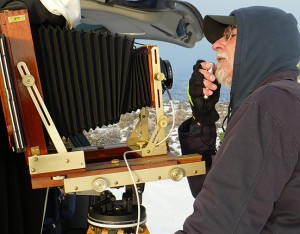
This Is How We Work With A View Camera.
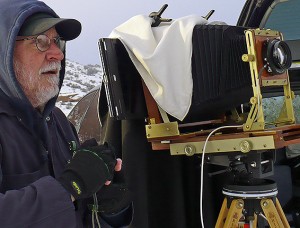
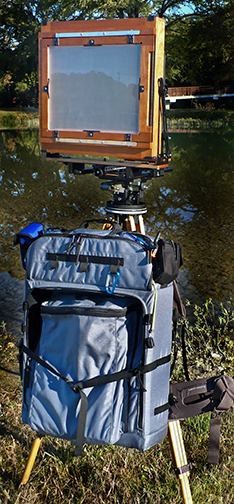 There is always a lot of discussion on how best to carry LF gear in the field. Seems that most people like to carry their camera in a backpack. That is our favorite mode of transportation in the field for sure. We like the backpack idea so much that Susan builds our packs to custom fit our cameras and accessories. All that we have learned about camera packs has been worked out the hard way. We have copied the features of commercial packs that we find useful and modified as required.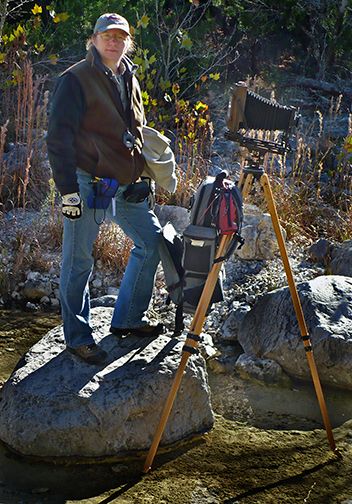
It seems that most people plop their pack down on the ground when they get ready to shoot. That is fine, unless you are in mud, water, or knee deep in snow. I have never liked the idea of setting my pack on the ground. And, yes I know, there are those that carry a tarp, but that is way too much trouble for me. I want to find my subject, plop down my tripod and then get to work without having to look for a convenient and safe place to put down the pack. This thinking led to a modification to both the tripod and the pack. Susan added a webbing loop to the top of the pack and I added a hook on the bottom of the tripod crown. This allows us to hang the pack from the tripod, keeping it out of the dirt and making it very accessible.
We both have worked out a system that allows us to carry everything we need and work efficiently in most any situation. The packs we use have a large compartment in the bottom for the camera and a separate top compartment for lenses and accessories. The custom packs also have room for several film holders.
This is how we do it and it has proven to be very efficient. However you choose to work in the field, the most important thing is to have everything you need with you, well protected, and easily within reach.
JB
 Back in February 2009 I posted an entry titled “
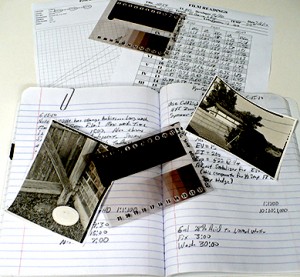
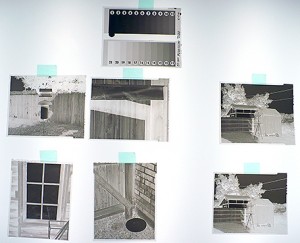
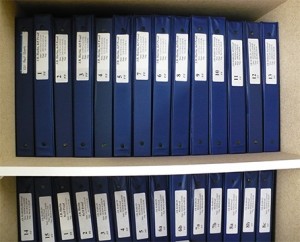 In the last entry I talked about making film notes in the field. That is the first step in the process of record keeping. I didn’t mention the last step which is negative storage. Each negative is marked on one edge with a unique number, then inserted into a clear sleeve then into an archival envelope. Each envelope has the negative number written on the upper edge. The envelopes are then placed into archival boxes, which are labeled with the contents. Also, the smaller film is proofed on our standard paper. These proof sheets are punched, and filed in binders. That pretty much sums up the negative end of the process.
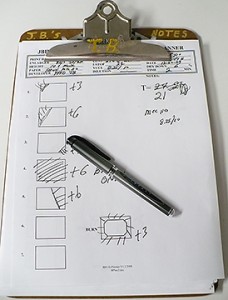 we use to record the process. We make our own print planner sheets using the computer to document every step in the darkroom. Our print planner sheets have spaces to record all pertinent information for the creation of a finished print. It includes the negative number and date, along with the print date, printing paper, developer, enlarger settings and such. The print planner sheet also has a series of boxes to record exposure manipulations. . . burning and dodging. That way if we ever need to go back and reprint, we have a record of exactly how we made the first prints. These sheets are filed in a three ring binder and labeled for future reference if needed.
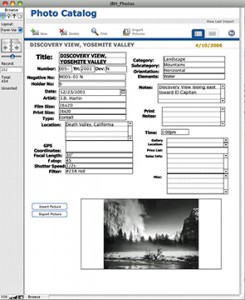 We also keep a computer database which contains our catalog of available photographs. This database contains all of the information from the film and printing notes. The master catalog database also contains information on the number of prints available, price, and exhibition information.
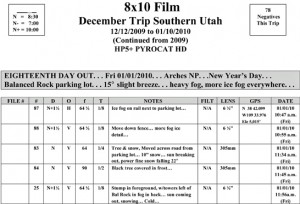
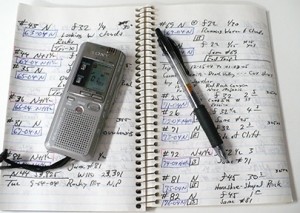 I have written quite a bit about LF and ULF photography here on the jbhphoto BLOG since we started back in January of 2009. A lot of it is my rambling about this or that, and sometimes I tend to repeat myself. Oh well, must be old age??? One thing that I do not remember writing about is keeping notes. We are both meticulous about keeping records of our travels and detailed notes on the film we shoot.
 the places we visit and are used to plan future trips and serve as a visual reminder of the places and things we discover. We also keep a daily diary/travel log of what, when, and where we were on a particular day. I have to admit that Susan is better at the diary than me, but at the end of every day before we drop off to la-la land, we try to type a few paragraphs. We keep this on a laptop computer and entries continue till the trip is over. It is a great resource, along with the snapshots, later when trying to come up with exactly what happened on any particular adventure.