09
Aug
2012
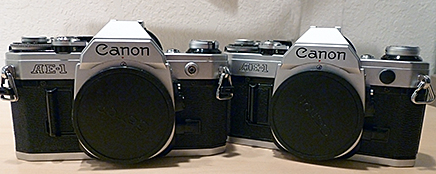 As I said the other day, gather your kids and grandkids and show them something that was built to last. . . here are two cameras that are near 35 years old and still work!
The other day I drug out my first camera bag from the storage closet. Inside was my two Canon AE-1 bodies and three lenses. They have seen little use in the last 20 or so years and at least I did remove the batteries from the cameras and the winders. Smart move there for sure!
The first thing I notice on inspection was the mirror damper and the body light seal material had turned to black goo. Yep, they used some of that open cell foam that over time deteriorates into a sticky mess. Seems that is the norm for these cameras, and others. I had a friend ask me about this several years back. I directed him to a seller on eBay that had seal replacement kits and he was able to resurrect his camera and is still using it. I had all intentions of doing the same, but just never got that round-to-it.
I decided that it was time to rework my 35mm cameras. They both still work, and neither has ever had the dreaded shutter squeak problem. I have my first AE-1 that I purchased in about 1978 and a second that I found later used. They have both seen a lot of action, yet I feel they are still as good as they ever were. . . just need to fix that goo problem.
Took a little digging, but I found a place that sells seal kits on the Internet. I ordered two kits and began the process of cleaning up the mess. By far, the hardest part of this is getting all that goo out of things, but it is something that can be done. It just takes a little patience, perseverance and denatured alcohol. If you have some vintage cameras laying around that need some light seal work, here is a place to purchase what you need;
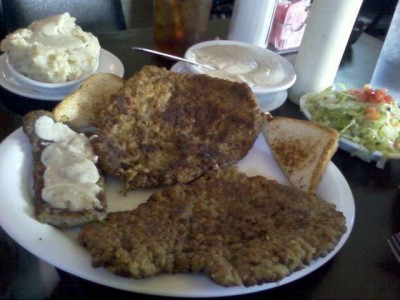 We are heading out to Strawn, Texas this Saturday (7-14) to Mary’s Cafe for the best Chicken Fried Steak in Texas. Some in the group are heading out early to scout the area and we will be meeting for lunch. Plans are to be at Mary’s for the real thing at 11:30AM this Saturday.
Mary’s Cafe
119 Grant Ave.
Strawn, TX 76475
Bring some photos to share, equipment to show or sell and let’s have a fun lunch.
Hope to meet some new members!
JB

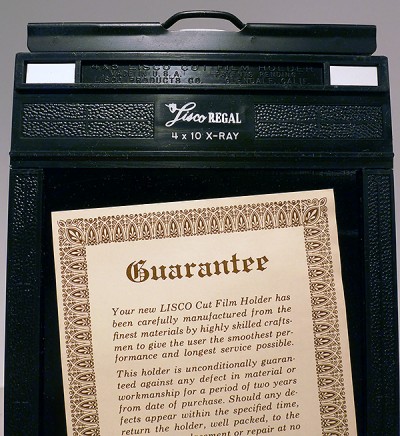 There are times when things fall into place. . . then there are those times when everything seems to just fall apart. My Mother used to say, “even a blind hog will pickup an acorn every now and then.” We struck on some good fortune recently and found something extremely rare. I found six, in-the-box, never-used, Lisco Regal 4×10 medical film holders. In case you didn’t know, Wisner designed his 4×10 camera around these extremely rare and difficult to find film holders.
 Susan started out with the Wisner 4×10 camera and a handful of holders, since we have forever been searching for more holders. She has found Wisner-style holders off and on and has collected a good assortment, but we are still on the lookout for more.
This group popped up on one of the photo chat sites and I couldn’t resist asking questions. The seller said he purchased them from another person that acquired them from a medical supply house and they were pristine. Pristine is an understatement! I still can’t get over how these holders look. The boxes were shelf worn, but the holders were absolutely un-used and still had the warranty cards.
It is strange how things sometimes happen, and here is one of those times I stumbled upon an acorn. These holders have found a good home and will be well cared for and put into service doing what they do best. . . holding film!

http://www.suntomoon.com/pages/Tri_framesets/gallery_tri_fs.html
[nggallery id=6]
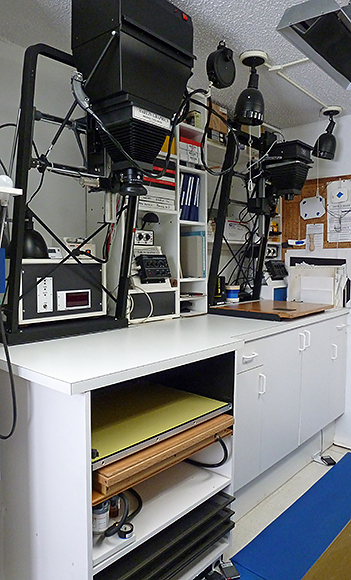 I have to admit that I am a contact printer. Susan and I both contact print. There seems to be some confusion about contact printing and all I can say is, it is the easiest way you can make a print. Contact printing is nothing more than laying the negative directly on a sheet of printing paper, covering it with a piece of glass, and adding some light for the exposure. Nothing could be more simple. You do not need any special equipment to print on graded paper. A negative, some graded paper, a sheet of glass, and a lamp.
As a side note at this point, note I use the term LAMP. I have been corrected for years by an old friend that worked in the lighting industry at one time. In the industry, there is no such thing as a Light Bulb. . . it is a LAMP. So when I say LAMP, you can be assured that to the laymen I am talking about a Light Bulb. Now back to contact printing.
You can contact print on any paper, but one of the more interesting papers that is highly sought after is the old Kodak Azo. Azo is a silver chloride printing paper that was manufactured primarily for making proofs. It is extremely slow and requires such a large amount of light to yield an image it is mostly used as a contact printing paper. There seems to be some confusion about printing on Azo, and believe me, it is not that complicated. You just have to use a light source that is bright enough to yield reasonable printing times. This is where the lamp comes in.
All you need for printing on Azo is a simple, frosted lamp. For small negatives, 4×5 or smaller you can use a sheet of thick glass for printing. Larger negatives require a printing frame that holds the paper and negative under pressure. Edward Weston printed most of his most famous work using an 8×10 negative in a simple spring back printing frame, exposed under a lamp hanging by its cord from the ceiling. He adjusted the lamp intensity by changing the lamp size, or moving the lamp up and down by coiling the cord and using a clothespin.
So, now we get down to designing a printing rig for Azo. This can be as simple or complicated as you wish. I am going to describe how we print Azo and other papers. This is the setup we use, and how it is designed. I will say this again, you can use this same setup for contact printing regular enlarging paper also.