Photography

COLD LIGHT?

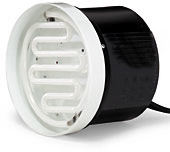
Ever wonder exactly how a Cold Light enlarger head works? How can light be Cold? The grid lamp-type enlarger light source definitely generates much less heat when compared to an incandescent light source. The heat of an incandescent lamp is generated by the infrared radiation produced by the heated filament in the lamp. A typical incandescent lamp produces more IR than visible light. In the simplest terms, the Cold Light does not generate that much IR, hence less heat. But what exactly is a Cold Light?

Most Cold Light enlarging heads contain what is known as cold cathode lighting. And, yes there is also what is known as hot cathode lighting. You say you have never heard of such things? Maybe not, but you see them both most every day. Cold cathode lighting is simply neon. That neon OPEN sign at the convenience store is a cold cathode light. The fluorescent light in your hallway is hot cathode lighting. In simplest of forms, they are both gas discharge lamps.

There are a few of the larger Cold Light enlarger heads that use fluorescent lamps, but most Cold Light heads contain cold cathode grid lamps. Without getting into a technical discussion, the usual Cold Light head is nothing but a neon sign. The glass lamp is bent into a grid instead of spelling out some advertising slogan or the word OPEN.

A cold cathode lamp depends on high voltage to operate. Your small Cold Light head will use a voltage around 6KV (6,000) volts. A larger head can use up to 12KV to operate. The high voltage source is current limited in order to keep the lamp from overheating. By adding different rare gasses and phosphor coatings inside the lamp it is possible to create different colors of light.

The dual grid Variable Contrast Cold Light (VCCL) heads, used with variable contrast papers, have two grids. One green grid for printing soft contrast and a blue grid for printing hard contrast. Adjusting the intensity of each lamp, by varying the voltage, allows you to mix different amounts of each light to achieved a continuously variable contrast grade on VC paper.

So, now you know! That Cold Light enlarger head is nothing more than a specially designed neon sign. And, one important thing to remember and this is important! There is very high voltage inside that Cold Light, so unless you know what you are doing, Keep Out!!!
JB

Posted by JB Harlin in Darkroom, Film, Photography

IS THAT AN OLD CAMERA?

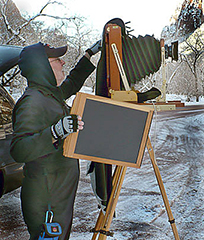
How many times have I been asked, “is that an old camera?” I usually have to explain that no, it is actually a modern version of an old camera. Seldom am I asked why I would use something like an old bellows-type camera. But I get the feeling that there are those that would like to ask why.
Am I the only one that believes that simplicity has its place? For me, it really has its place when it comes to my art form. When I get out in the field, I want the equipment to become transparent in its function. And, the best way I have found to achieve this transparency is through simplicity.

I have started a list of things that I like about using a view camera. It goes something like this:

No batteries
No multi-function buttons
No multi-layered menus
No planned obsolescence
No little tiny buttons to locate
Nothing new to learn
Nothing to upgrade

I am sure with a little more time I could think of more, but I am sure you get the idea. I love the feel of a view camera. I love the feel of a view camera on a very large, heavy, wooden tripod. I love to climb under the dark cloth and just look at the ground glass. I love the fact that the image is upside down. Nothing will do more to improve your compositions than a flipped image. I like the slow pace of the view camera. I love spending an afternoon just exposing two sheets of film of one subject. Waiting for the light. Waiting for things to come together just right. I like the idea of having only one chance to make the image. I love to just stand next to the camera all set up and ready to click the shutter and just wait. I hate to be rushed. I hate to be pressured. And if things don’t work out, I can just put the camera up and head home. Nothing gained, nothing lost. There are times when just being out there with the camera is the best part of the entire experience. It is great when I bring home a really nice image, but not always necessary.

So. . . does anyone reading this believe I am a view camera advocate? Yep, that pretty much describes me. I would never even consider making a serious photograph with anything but a view camera loaded with B&W film. Just me, but I love what I do, and now you know why.

JB

Posted by JB Harlin in Commentary, Film, Photography

IS THAT A FENDER THIN?

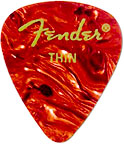
Unless you play guitar, you probably have never heard of a Fender Thin. If you are not a guitar connoisseur, it is a guitar pick. Now why on earth would someone that shoots LF and ULF be interested in a guitar pick, you ask?

Ever try to unload a sheet film holder while wearing Nitrile gloves? Or ever had a sheet of film that has a slight rearward curl. Then you know how difficult it is sometimes to get your finger under the sheet to remove it from the film holder. Now do you see the value of a thin guitar pick?

I keep a small container of thin guitar picks near the back of the enlarger baseboard where I normally unload film. I can locate my stash of picks in the dark and they are invaluable sometimes to get that stubborn sheet of film coaxed out of the film holder without excessive handling or damage. A thin guitar pick can easily be slipped under the film to allow you to get your finger under the film edge.

The next time you see a music store, stop in and purchase a few thin guitar picks. They could save you a lot of frustration. Who knows, you might want to take up the guitar!

Finally, just for the record, I really don’t use a Fender Thin. I prefer the super thin nylon 0.46mm pick sold under the Jim Dunlop name. In case anyone is really interested.

JB

Posted by JB Harlin in Commentary, Film, Photography

WHAT CAN GO WRONG?

Seems as you shoot larger and larger formats, you find more and more mistakes to make. Anyone that has spent much time with a view camera knows all of those common mistakes you can make. No matter how experienced you are, and what you do to create a routine, something happens every now and then.
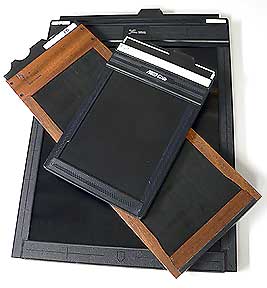
Just to name a few things that will come up to ruin your film; you pull the dark slide without closing the lens; you forget to set the aperture; you forget to pull the dark slide; you forget to cock the shutter, and the noise of the running water is so loud you cannot hear if the shutter fired; you fail to get the film holder properly seated in the camera back; there is dust on the film, always right in a nice even area of sky; strange light leaks; lens flare; camera flare; you kick the tripod after taking forever to get the image framed just right; and don’t forget double exposure. This can go on and on. Any number of other things, can and will happen, that are just right to ruin that great photograph.

These things never happened to you? Bet it has, even if you are not willing to admit it. All of the above, and many more, have certainly happened to me. The only way to lessen mistakes is to establish a routine. Do everything in the same order and double check as you go. But, even then, every now and again, something will get you. Just learn to live with it. Mistakes are one thing we all share in common. It is just part of being human. But I still reserve the right to express a few choice words when I screw up a good image.

JB

Posted by JB Harlin in Commentary, Photography

SHEET FILM NUMBERING

How do you identify sheet film? You put unique numbers on the film holder, but how can you identify which sheet of film came from any particular holder? You may be able to identify the film by taking notes and knowing the subject. But, what if you make several exposures of the same scene, say using different filters? How do you know which filter was used on each sheet?
We hit this impasse many years ago and I came up with a simple solution that has worked for us for years. All you have to do is file a notch code into the film loading flap. We have used this system to number over one hundred 4×5 holders. Want to learn how to modify your film holders? Take a look at “A QUICK & EASY SHEET FILM NUMBERING SYSTEM” for the details.

Hope you find this helpful. . .

JB

Posted by JB Harlin in DIY, Film, How-To, Photography

WHO USES PYRO?

We have been using Pyro based film developers for some time now. So, what is it about a Pyro negative that makes it so desirable? I have yet to completely understand the desirability of the Pyro negative, but I do know there is a depth that just isn’t there with other more popular film developers.

We used Kodak HC110 for years. We even had our own dilution, that we used based on years of experience with the developer. But once persuaded to try Pyro, the HC110 negatives soon became undesirable. I guess the question is, if you have tried one of the Pyro formulas, did anyone else find that little something extra? Or is it just the mystique of using one of the oldest known developers? There has to be something. I can see it in the negative and the print.

I have been doing a series of detailed tests comparing several of the modern Pyro film developer formulas trying to pick the one that best suits what we do. One thing that is odd is to see all of the different colors of image stain, ranging from near neutral gray to bright green. I have about reached a conclusion as to which formula best suits what we do. . . and. . . I may just write about what I found at a later date. . .

JB

Posted by JB Harlin in Darkroom, Film, Photography, The Darkroom Workshop

THE SHOW RETURNS???

SHOWWe just attended our local Camera Show today. And, I can say that we were pleasantly surprised at the turnout. There were people there! Actually, a lot of people. More than we have seen in several years.<

The local Camera Show scene has dwindled as Internet auctions have taken over the used camera market. We had begun to accept the possibility that apparently all of the dedicated show dealers, and even the local sellers, had stopped attending the shows and relegated all sales to the auction sites. Yet, after today I see what just may be a change in the trend.

It seems that just maybe, people are not as obsessed with the on-line experience as first thought. There is something about being able to touch the merchandise. To be able to see the seller, and the buyer, in person, to be able to haggle face to face. Maybe, just maybe, there is room for both Internet sales and the real, touchy/feely, old-time Camera Show/swap meet. I now feel that though the Camera Show will never be as prevalent as in its heyday, it is not doomed to disappear from the face of the earth. Maybe there is room for both the Camera Show and the Internet?????

I certainly hope so! We buy from the Internet, but we really do enjoy going to a Camera Show and digging through that box on the floor under the table.

Posted by JB Harlin in Commentary, Photography

HAVE YOU EVER HEARD OF FRED PICKER?

ZONE VINever heard of Fred Picker? How about Zone VI Studios? If not, and if you are a serious practitioner of photographic art, I would suggest you learn about all of the aforementioned.
Fred Picker originally was a commercial photographer that developed a one-of-a-kind photographic specialties business in Vermont. Zone VI Studios manufactured and sold view cameras, B&W darkroom supplies and custom built equipment. Sadly Fred sold Zone VI to Calumet Photographic in the 1990’s. He stayed on for a few years and finally retired completely. Calumet has slowly phased out Zone VI products and they are now relegated to only being available used. Sadly Fred died in 2002. This was a great loss to the photographic community.

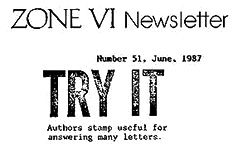
One of the best things that Fred left for all of us fellow artists is his newsletter. He published the Zone VI Newsletter, a quarterly little pamphlet filled with wisdom, wit and information, from 1973 till 1995. There are 83 newsletters in the collection and if you can find a set for a reasonable price, buy it! (Watch eBay)

Fred Picker also authored a great book for the beginning B&W photographer titled “The Zone VI Workshop.” This is another good book to add to your library. It is based on simplicity itself, and if you are a beginner experimenting with B&W, you need to read this book.

If you can find a copy of one of the Zone VI Catalogs, this is also a great reference for your collection. Not that any of the items are still available, but just as a collector’s item for your reference.

We still own Zone VI 4×5 and 8×10 cameras. These are well-designed, rugged, bullet-proof view cameras. If you are thinking of getting a wooden field camera, be sure not to pass up a look at a used Zone VI.

Zone VI also manufactured several innovative and unusual pieces of equipment for the darkroom. The Zone VI Compensating Enlarging Timer and Compensating Developing Timer are a permanent fixture in our darkroom. Though none of this equipment is available new, you can find it used. Check out eBay, and be ready to pay near original retail for some items. They are that good!

So. . . if you have never heard of Fred Picker, and are serious about B&W photography, you should take the time to familiarize yourself with the man and his products. We have a complete Zone VI Newsletter Index on our web site available FREE as a PDF download. Look in the Articles Area.

Posted by JB Harlin in Commentary, Darkroom, Film, Photography

DON’T GET TOO HUNG UP ON TESTING

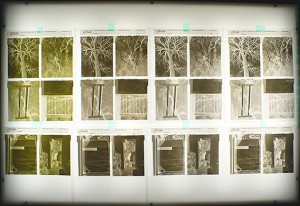
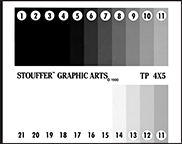
SCALEWe have been on a quest for that little something extra in the photographic print. There are great prints, then there are prints that have that magical something. Printing comprises a great deal of the quality of the finished print, but you have to have the information on the negative before you can make the print. We have used Pyro film developers for some time now, and every time we find a new formula we do a little film testing and then eagerly head to the field to see what we have.
We have had great luck with several of the modern Pyro developers, but it has become confusing as to exactly what each formula did that made us change. So we have embarked on an all-inclusive, side-by-side, test of our favorite four Pyro developers.

This has turned into a little more of a project than originally anticipated. We had to design and build a film sensitometer. Then we had to gather data, plot curves and evaluate them. Then it was off to field testing. No laboratory test will tell you what the real world result will be. But knowledge is power and squeezing every little bit out of your film is what makes great images. You have to push the limits and find the boundaries.

This has been quite an experience, all in all, and I would not suggest anyone go to such lengths unless you are really curious. The bottom line is, don’t get too hung up on testing. You can waste a lot of time testing. Sometimes you are better off just getting out and making photos. Make the mistakes in the real world, find the answer, solve the problem and get on with your work. You can look at what you bring back and make the necessary adjustment on the fly. Or, you could build a sensitometer and do the testing. It is up to you just how far you really want to go. Just remember, do not let the testing get in the way of your creativity!

In a nutshell: Do not spend a disproportionate amount of your time testing!

JB

Posted by JB Harlin in Darkroom, Film, Photography, The Darkroom Workshop

WHERE HAVE ALL OF THE PHOTOGRAPHY CLUBS GONE?

JB Harlin With 11x14 Camera

JB Harlin With 11×14 Camera

To answer that question, Camera Clubs have turned into Computer Clubs! Why? I really do not know why, but I have an idea.

People in general are consumer driven by what the large manufacturers say and do. Certain large, should I say behemoth, manufacturers have taken the initiative to try and influence the photographic market place. Corporate bean counters are forever trying to enhance the bottom line. These so called Harvard MBA’s have little to no experience in reality, they just look to their book learning and spread sheets for bigger, better, faster. They are paid to find pie-in-the-sky schemes that look good for the bottom line. They know little about the product nor its users. And, they really don’t care about anything beyond the quarterly report to the board and share holders. This mindset has filtered into the film photography industry. They don’t care about their product nor their customers beyond what they can get from either or both. Hence the battle cry “Film Is Dead” has gone out through the photography world because someone thinks that is where they can make the most money. And, people, sadly most people, follow like sheep. Repeating the call and believing it is true.

How many times have I been asked, “where do you get film for that camera?” This gets really old in a hurry, but the reality is, people are just misinformed. Way too much TV, radio, magazine ads, billboards, newspapers, Internet, etc, for anyone’s good. We, as a society, are pounded day and night with endless advertising. And, sadly, we believe it! “We couldn’t say it on TV if is wasn’t true” is something I hear on some infomercial. Remember, advertisers will tell you anything to get your money!

OK, so what does this have to do with the Camera/Computer Club? It seems that they have become one of the sources for the misconception of the Film Is Dead hoax. Go to most any club, bring up film, and you will be instantly told there is no such thing. It is not that they are trying to intentionally mislead, they are just misinformed. They have bought into the hoax, because it is what they have heard somewhere. And what ticks me off is the fact that they continue to spread false information.

My wife and myself in the past were involved with camera clubs. Why? Because it was a place to meet like-minded individuals and share our interests. Several years ago we found that more and more we had little in common with the other members. They were speaking in tongues, discussing materials and equipment we knew nothing about and had no interest in learning. You can say we lost that ‘like mindedness.’ We cease to be interested and are no longer members.

So, why should this bother me? Because misinformation is detrimental to creativity and the art of photography. I really don’t care if you shoot digital. It is simple; Digital Is Its Own Art Form! Acrylic paint did not replace oil for the painter. In this modern age, people still use candles, hand write letters, ride horses, and who knows what else that has evolved into some more up-to-the-minute technology. Why this all-out move to kill film photography and to try and convince anyone interested that digital is the only choice?

What bothers me is the fact that clubs preach from the rafters the falsehood that film is gone. What if someone wanting to express their artistic vision joins a camera club to learn the craft? They are told film is no longer manufactured, not available, don’t bother. Then they spend their time and money working with digital only to learn later that film is still alive and possibly more important, the direction more suitable to their vision. Film is another medium for their expression. They have now wasted valuable time and resources exploring a medium that is not suitable to their creativity.

A good club, at least for me, would foster all forms of photography, from digital, to the most extreme alternative processes. That way those interested in the medium could see what is really available and make the choice as to which process is right for them. The world is not a one-size-fits-all society. Creative people have something to say. They may write, sculpt, paint or photograph. What is important to the beginner is that they see what their options are, so they can make an intelligent choice. No one should be funneled down the wrong path just because the local Computer Club feeds them a line of BS based on a hoax. If you are just starting out in photography, be very careful if you choose to start with a Camera Club! It could just cost you the most valuable commodity you have. . . TIME!!!

And, to those that are in charge of the local camera clubs, pull your head out of the sand and look around. There is an entire world of photographic imaging, from digital to exotic alternative processes where you create your own emulsions. You just have to look for it somewhere beyond the narrow minded Hoax of Film Is Dead. Please, don’t tell the next new person that comes to a meeting that digital is the only game in town!!!

JB

Posted by JB Harlin in Commentary, Darkroom, Film, Photography