
 Once you become a serious darkroom worker you will eventually want a real darkroom sink with running water. The question is, to buy, or to build? Certainly, if you have deep pockets, you can buy a commercial stainless steel sink. You can even have a stainless sink custom fabricated. Just be forewarned, you are looking at a serious amount of money.
What most do is build their own sink, typically from wood. This is my favorite construction technique and allows me to build a very functional sink to any size required. In the previous post titled “NOT THE KITCHEN SINK” we showed what it took to build a large darkroom sink from wood. Robust construction is essential to make sure the sink does not flex. Flexing can cause the finish to crack and begin to leak.
My philosophy of sink building is to build the thing like a boat. Using construction robust enough to sail the ocean. That way it is strong enough to stand up to most anything. Once complete, I like to climb into the sink and jump up and down. If nothing moves, creaks, or breaks, I am satisfied that I have a good strong sink.
Waterproofing is the next order of business. Caulking all seams is a must to insure no leaks. Next comes some form of durable, waterproof coating. I built one sink years ago and used fiberglass. Never again! Way too messy for me, and I hate working with the stuff.
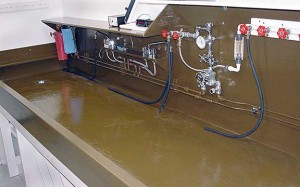
After much research I found a suitable coating for my darkroom sink. Tile-Clad® HS Epoxy is a two-part, commercial-grade, epoxy-polyamide coating from Sherwin-Williams. This epoxy paint is used in power plants, offshore structures, schools, storage tanks, laboratories, hospitals and marine applications. This stuff dries rock hard and is near impervious to most chemicals.
I have found that two generous coats of Tile-Clad® makes a great smooth waterproof finish for a darkroom sink. You can also have the paint tinted to most any color you desire. Most any Sherwin-Williams store should have Tile-Clad® and be able to tint it for you. Be prepared, this material is not cheap. Seven years ago when we built our last sink it was about $110.00 for a gallon of part ‘A’ and part ‘B’ which, when mixed, makes two gallons of paint.

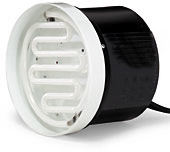 Ever wonder exactly how a Cold Light enlarger head works? How can light be Cold? The grid lamp-type enlarger light source definitely generates much less heat when compared to an incandescent light source. The heat of an incandescent lamp is generated by the infrared radiation produced by the heated filament in the lamp. A typical incandescent lamp produces more IR than visible light. In the simplest terms, the Cold Light does not generate that much IR, hence less heat. But what exactly is a Cold Light?
 How many times have I been asked, “is that an old camera?” I usually have to explain that no, it is actually a modern version of an old camera. Seldom am I asked why I would use something like an old bellows-type camera. But I get the feeling that there are those that would like to ask why.
 Unless you play guitar, you probably have never heard of a Fender Thin. If you are not a guitar connoisseur, it is a guitar pick. Now why on earth would someone that shoots LF and ULF be interested in a guitar pick, you ask?
 Seems as you shoot larger and larger formats, you find more and more mistakes to make. Anyone that has spent much time with a view camera knows all of those common mistakes you can make. No matter how experienced you are, and what you do to create a routine, something happens every now and then.
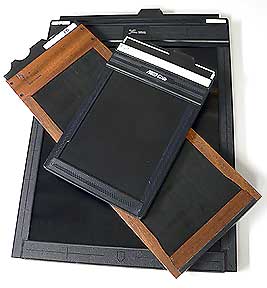 How do you identify sheet film? You put unique numbers on the film holder, but how can you identify which sheet of film came from any particular holder? You may be able to identify the film by taking notes and knowing the subject. But, what if you make several exposures of the same scene, say using different filters? How do you know which filter was used on each sheet?