 In a previous post I talked about issues that seem to crop up when shooting sheet film. When I refer to issues, I am talking about things you can do unintentionally that may or may not ruin a particular negative. See my previous post “WHAT CAN GO WRONG?” for a better idea of the issues.
We spent the entire month of December 2008 in Utah. This was one of our typical photo trips and we were there to make photographs. This trip we brought back 276 sheets of film in four formats ranging from 4×10 to 11×14.
Mistakes? Who makes mistakes? Issues? What Issues? Of the film that I exposed, I had 136 sheets in two sizes. Of those sheets, there were three sheets that I ruined, due to just plain dumb mistakes.
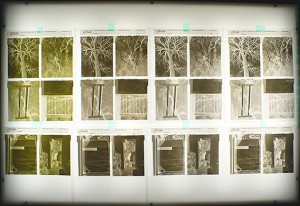
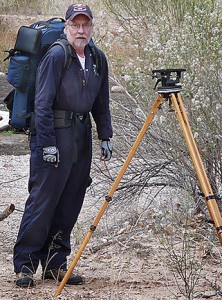
At lot of my mistakes come near the end of the day, when I am tired. Lugging 40-50 pounds all day in the snow will wear you down. I do make mistakes. No matter how hard I try, I seem to always screw up a few sheets of film. The biggest one this trip you ask? I double exposed an absolutely great photo of glowing cottonwood trees. I now have this strange 8×10 negative with two large trees. . . at right angles! Yes, the first exposure was a horizontal, the second was vertical. Oh well. I did make several other negatives of the same tree, so not all is lost. And as I said in my previous post, I had a few choice words!
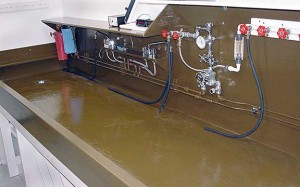
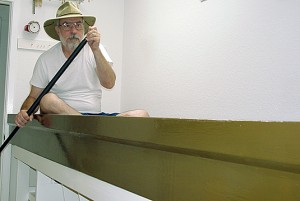 Once you become a serious darkroom worker you will eventually want a real darkroom sink with running water. The question is, to buy, or to build? Certainly, if you have deep pockets, you can buy a commercial stainless steel sink. You can even have a stainless sink custom fabricated. Just be forewarned, you are looking at a serious amount of money.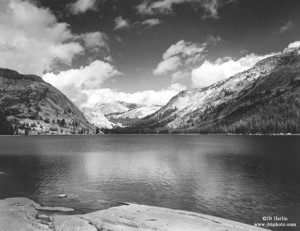
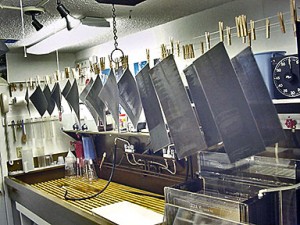
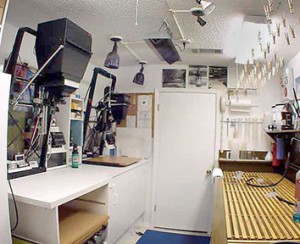
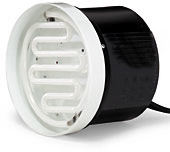 Ever wonder exactly how a Cold Light enlarger head works? How can light be Cold? The grid lamp-type enlarger light source definitely generates much less heat when compared to an incandescent light source. The heat of an incandescent lamp is generated by the infrared radiation produced by the heated filament in the lamp. A typical incandescent lamp produces more IR than visible light. In the simplest terms, the Cold Light does not generate that much IR, hence less heat. But what exactly is a Cold Light?
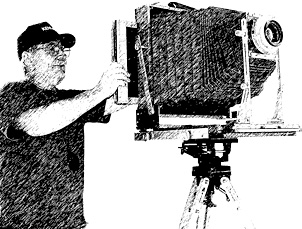 How many times have I been asked, “is that an old camera?” I usually have to explain that no, it is actually a modern version of an old camera. Seldom am I asked why I would use something like an old bellows-type camera. But I get the feeling that there are those that would like to ask why.
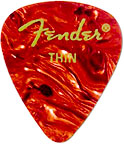 Unless you play guitar, you probably have never heard of a Fender Thin. If you are not a guitar connoisseur, it is a guitar pick. Now why on earth would someone that shoots LF and ULF be interested in a guitar pick, you ask?
 Seems as you shoot larger and larger formats, you find more and more mistakes to make. Anyone that has spent much time with a view camera knows all of those common mistakes you can make. No matter how experienced you are, and what you do to create a routine, something happens every now and then.