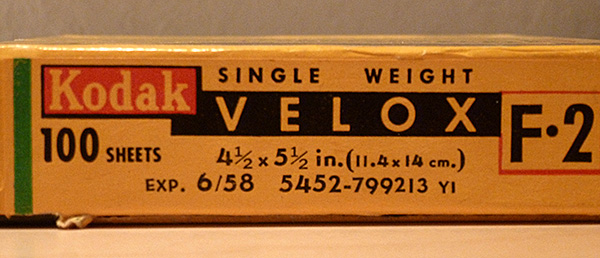
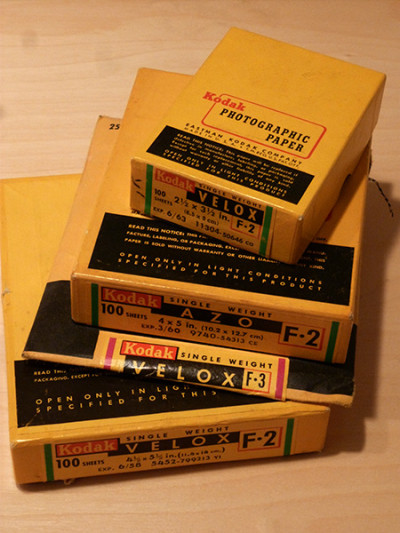
There seems to be a lot of people interested in the traditional wet darkroom these days. As many abandon their darkrooms, others are just getting started. I have seen numerous transfers of darkroom materials, chemicals and hardware to newcomers interested in the wet darkroom. . . a lot of times for FREE. There is a lot of old printing paper coming out of storage and being either tossed in the garbage or passed on (without any guarantee what so ever) to those that are just starting out. Certainly a lot of this old paper is fogged to some extent. . . but all may not be lost. If you find yourself in possession of several thousand sheets of a really great paper, depending on the amount of fog, you just may be able to make excellent prints, despite a little general degradation.
 Paper fog, as a rule shows up as a general darkening of the processed paper, thus making pure white in the print an impossibility. You can easily test for paper fog. . . see my previous article, “MEASURING PAPER FOG” for my method for testing paper.
Success is very dependent on the image you are printing, but in most cases, fog can be eliminated in the highlights and whites of the print by simply doing a little selective bleaching. Even deep shadows can be livened up with a little work with a bleaching mixture and a brush. Selective bleaching is not difficult and here is more info from a previous post titled, “A LITTLE SELECTIVE BLEACHING.”
If the whole print requires overall livening up, you can bleach the entire print in a tray. Look up the formula for Farmer’s Reducer. You may find that you have to over-print the image (print a little too dark) and then bleach it back upward (lightening the image) to restore the image sparkle. You will just have to experiment and find what works best for each print.
Realize that if the paper has severe fog or a mottled, spotty fog, this method will not be of much help. Also keep in mind that even severely fogged paper can sometimes be fixed out and used for other processes. Many carbon transfer printers used old, fixed out paper for their finished images. Old, fogged paper should not be thrown out without first, at the very least, trying to find if it is in some way useable. You never know. . . that free, old out-of-date paper may be a really good deal after all!
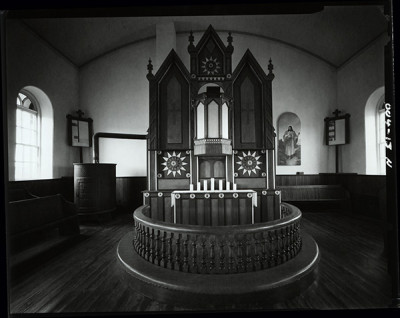
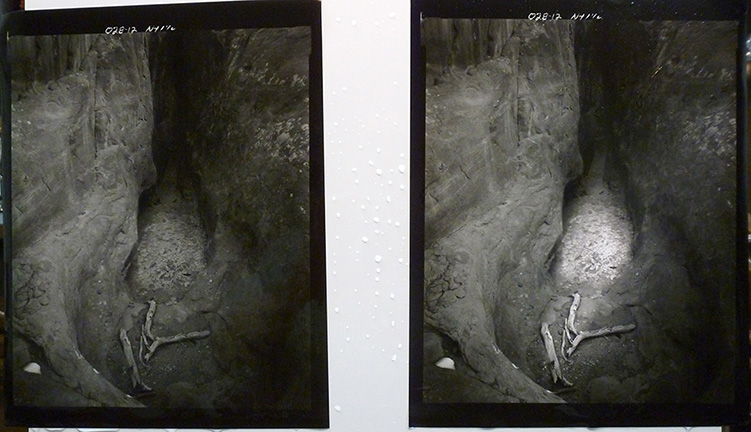
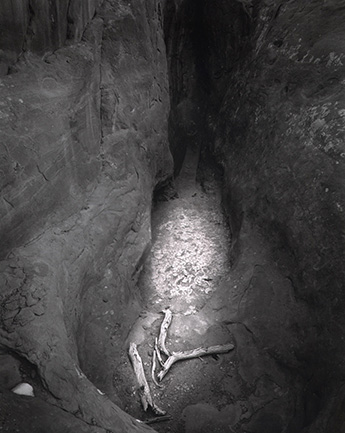
4×5 Contact Print on vintage Velox paper, expiration date of 1958
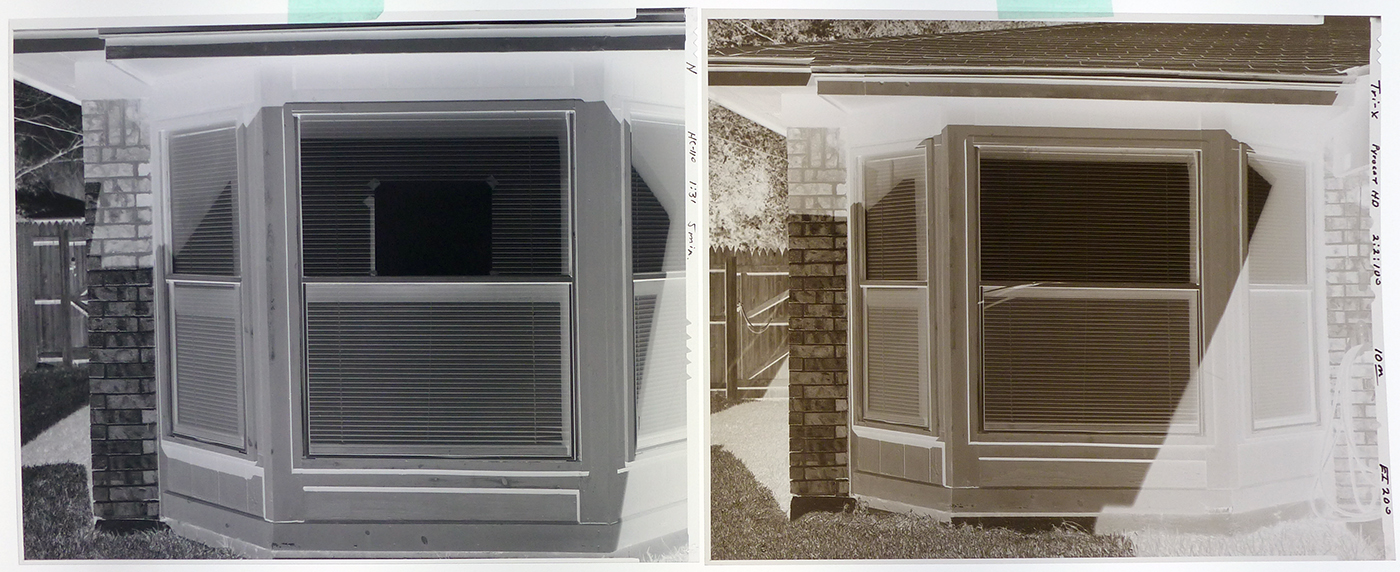 When we first started working with Pyro developers it took some time to realize exactly how the different look and feel of the film would translate into the finished print. There are those that say there is no difference between different film developers. They may also say there is no difference in the film you choose. That is like saying there is no difference between Ford and Chevy; no difference between red or white wine. Maybe for some this may be the case. But for those that take the time to really look and absorb the image, there is always a difference. Fred Picker said, “different is not the same!”
 Over the past 20 or so years Pyro film developers have again become popular, with modern reformulations for modern film. John Wimberley, Gordon Hutchings, Sandy King, Jay DeFehr, among others, have done a lot of research and have formulated numerous reincarnations of Pyro film developers, specifically designed for use with modern film. Steve Sherman, Bob Herbst, Michael A. Smith and Steve Simmons have written extensively about Pyro developers and their unique qualities. Susan and I have made our choice based on our own real world experiences. We join with the many others that are also Pyro developer users.
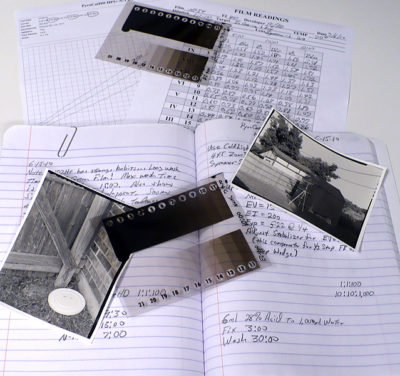
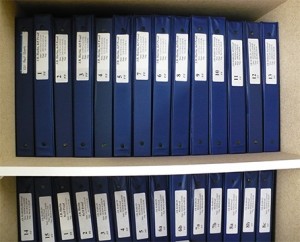 In the last entry I talked about making film notes in the field. That is the first step in the process of record keeping. I didn’t mention the last step which is negative storage. Each negative is marked on one edge with a unique number, then inserted into a clear sleeve then into an archival envelope. Each envelope has the negative number written on the upper edge. The envelopes are then placed into archival boxes, which are labeled with the contents. Also, the smaller film is proofed on our standard paper. These proof sheets are punched, and filed in binders. That pretty much sums up the negative end of the process.
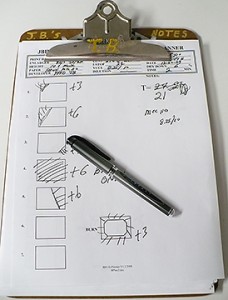 we use to record the process. We make our own print planner sheets using the computer to document every step in the darkroom. Our print planner sheets have spaces to record all pertinent information for the creation of a finished print. It includes the negative number and date, along with the print date, printing paper, developer, enlarger settings and such. The print planner sheet also has a series of boxes to record exposure manipulations. . . burning and dodging. That way if we ever need to go back and reprint, we have a record of exactly how we made the first prints. These sheets are filed in a three ring binder and labeled for future reference if needed.
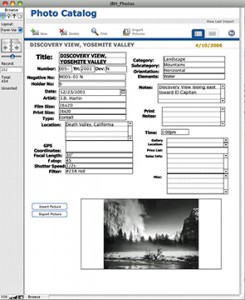 We also keep a computer database which contains our catalog of available photographs. This database contains all of the information from the film and printing notes. The master catalog database also contains information on the number of prints available, price, and exhibition information.