‘Before making a print, let me remind you again that you must first make the proper proof in order to select the negative for printing.’
‘Please do not short cut this step. An outstanding print is always the product of an outstanding negative. No one can positively translate negative densities – as seen on a viewing table – into emotional values. You must see the way it prints. The proper proof identifies the qualities of the negative.’
-Fred Picker, ZONE VI WORKSHOP; The Fine Print In Black & White Photography, Amphoto, Garden City, NY, 1974, p. 44-
 While working on all of the negatives from our last trip, and a couple of local outings, I began thinking about proofing and just how important the proof is to the fine art photograph. I guess I take a lot of what I do for granted and seem to believe that everyone else understands the process. This may not be all that true and maybe it would be a good idea to emphasize in a little more detail the importance of proofing.
I gained the most in my creative photographic endeavors when I discovered Fred Picker and his little book titled “ZONE VI WORKSHOP.” This little book is short and sweet, yet packed with a lot of information. You might say it is deceptively simple and short.
I believe the above quoted paragraphs from the chapter titled “THE FINE PRINT” pretty much sums up one of the most important steps in the photographic process. You have to see what you have captured on the film before you can decide to make the finished fine print. The proper proof is your absolute verification as to the validity of the negative. It is your guide, your control and provides the necessary information for the next step. . . the finished print.
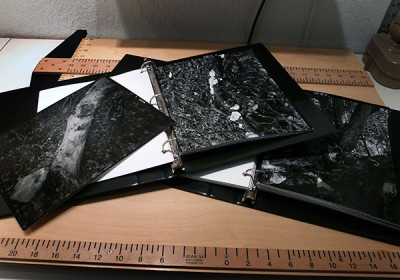
We proper proof and file our proper proofs into 3-ring notebooks. This is where the second half of the creative process begins. (The first step is finding something worthy of capturing on film.) I highly recommend you proper proof every negative you make. This way you will know what your are doing and what you have to work with. The proper proof will also reveal any shortcomings or problems you may have with your equipment or technique. As Fred says, “Please do not shortcut this step.” I agree and feel it is a very important step in the creative photographic process.
Are you interested in learning more about the art and craft of black & white photography and Proper Proofing? We have created an e-book series especially for you. Within in the pages of “The Film Exposure Work Book” you will learn how to preform your own film tests and how to make proper proofs. You will find more information at our BOOK STORE.
JB & Susan
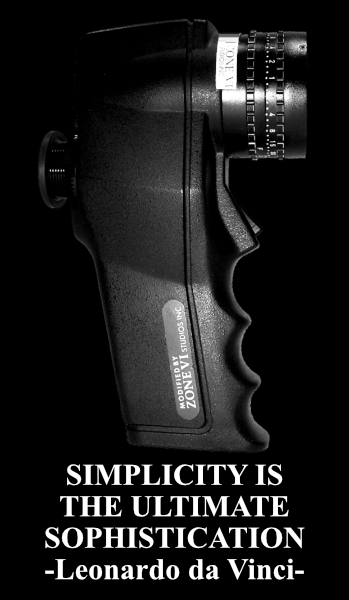
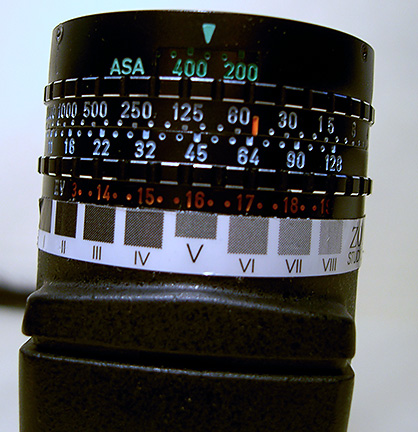 So, I know that I really should spend more time talking about photography, but it is so much easier to talk about equipment and modifications. . . so. . . here we go again. I know I have said several times before that little around here has not been modified in some way. I have to say that my Pentax Digital Spot Meter is about my number one tool when photographing. Maybe I should say it is my only tool that has a battery. No wonder Paul Horowitz chose it to modify for Zone VI. I like everything about it, except the Zone Dial. Now don’t get me wrong here, the old Zone VI Zone Dial was plenty useable. It was just that the label was not that durable and though we had purchased replacement Zone scales, I wanted something that was more rugged. So, this is how it all started. I just wanted to make a better label. And, another complaint I had was that part of the Zone Scale was covered by the meter barrel.
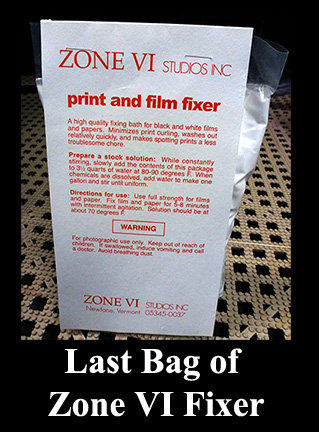
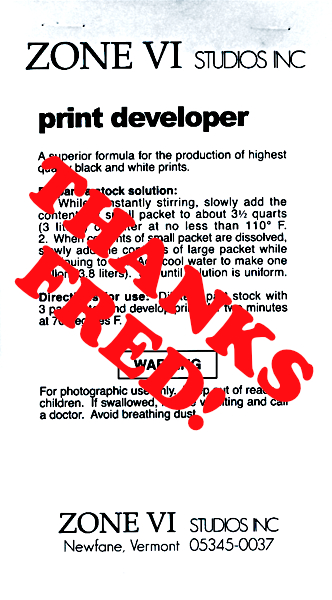 It has finally happened! I have used Zone VI chemicals for well over twenty five years now. Though we have moved on to different formulations for finished prints, we have continued to use Zone VI Print Developer for proofing. That is. . . until now. I mixed the last bag for proofing our 2015/2016 trip and that is that. This has been a looming change that has been in the back of my mind for several years now and it finally came time to do some testing. OH Drat. . . TESTING!!!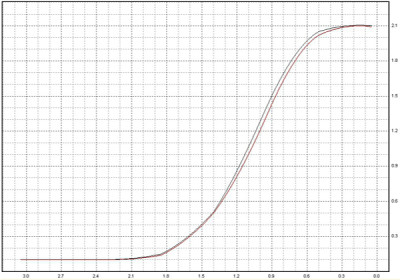
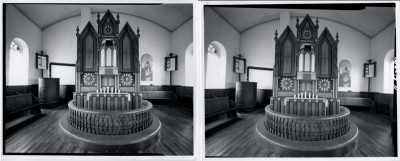
 Seems everyone has their favorite method for exposing and developing film. You do shoot film, don’t you? If not, you should! But I digress for sure. . . There are as many ways of working with film as there are opinions. . . maybe more. None are better or worse than any other, if they work; if they give you the results you insist on within your own vision, then you are already there. But, in this day and age there are a lot of people coming into photography and just now discovering film and the traditional darkroom. In the beginning film is a mystery and requires some time to begin to master. Of course, the most important thing is that you shoot film and make finished photographs. How you get there is a very personal thing and you need to choose what works best for you. But, you have to start somewhere.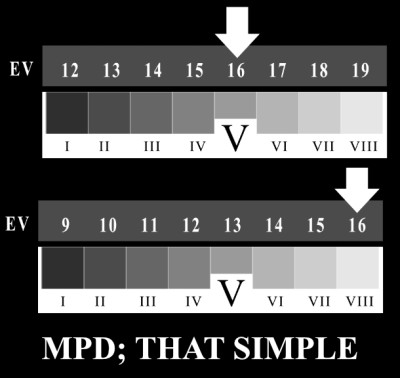
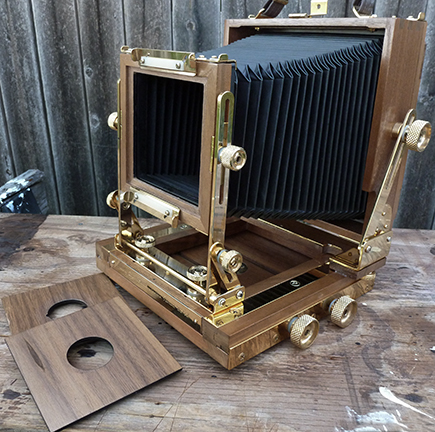
 What are you looking for? A new camera? Pieces and parts? A new lens? We are cleaning out our equipment closet and it is time for some things to go to someone that can use them. The excess equipment we no longer need may be just what you are looking for.