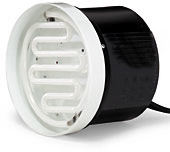
 Ever wonder exactly how a Cold Light enlarger head works? How can light be Cold? The grid lamp-type enlarger light source definitely generates much less heat when compared to an incandescent light source. The heat of an incandescent lamp is generated by the infrared radiation produced by the heated filament in the lamp. A typical incandescent lamp produces more IR than visible light. In the simplest terms, the Cold Light does not generate that much IR, hence less heat. But what exactly is a Cold Light?
Most Cold Light enlarging heads contain what is known as cold cathode lighting. And, yes there is also what is known as hot cathode lighting. You say you have never heard of such things? Maybe not, but you see them both most every day. Cold cathode lighting is simply neon. That neon OPEN sign at the convenience store is a cold cathode light. The fluorescent light in your hallway is hot cathode lighting. In simplest of forms, they are both gas discharge lamps.
There are a few of the larger Cold Light enlarger heads that use fluorescent lamps, but most Cold Light heads contain cold cathode grid lamps. Without getting into a technical discussion, the usual Cold Light head is nothing but a neon sign. The glass lamp is bent into a grid instead of spelling out some advertising slogan or the word OPEN.
A cold cathode lamp depends on high voltage to operate. Your small Cold Light head will use a voltage around 6KV (6,000) volts. A larger head can use up to 12KV to operate. The high voltage source is current limited in order to keep the lamp from overheating. By adding different rare gasses and phosphor coatings inside the lamp it is possible to create different colors of light.
The dual grid Variable Contrast Cold Light (VCCL) heads, used with variable contrast papers, have two grids. One green grid for printing soft contrast and a blue grid for printing hard contrast. Adjusting the intensity of each lamp, by varying the voltage, allows you to mix different amounts of each light to achieved a continuously variable contrast grade on VC paper.
So, now you know! That Cold Light enlarger head is nothing more than a specially designed neon sign. And, one important thing to remember and this is important! There is very high voltage inside that Cold Light, so unless you know what you are doing, Keep Out!!!
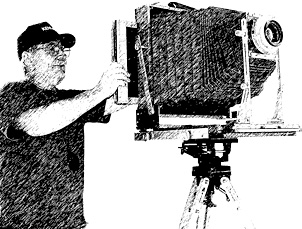 How many times have I been asked, “is that an old camera?” I usually have to explain that no, it is actually a modern version of an old camera. Seldom am I asked why I would use something like an old bellows-type camera. But I get the feeling that there are those that would like to ask why.
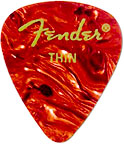 Unless you play guitar, you probably have never heard of a Fender Thin. If you are not a guitar connoisseur, it is a guitar pick. Now why on earth would someone that shoots LF and ULF be interested in a guitar pick, you ask?
 Seems as you shoot larger and larger formats, you find more and more mistakes to make. Anyone that has spent much time with a view camera knows all of those common mistakes you can make. No matter how experienced you are, and what you do to create a routine, something happens every now and then.
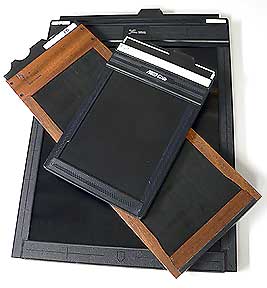 How do you identify sheet film? You put unique numbers on the film holder, but how can you identify which sheet of film came from any particular holder? You may be able to identify the film by taking notes and knowing the subject. But, what if you make several exposures of the same scene, say using different filters? How do you know which filter was used on each sheet?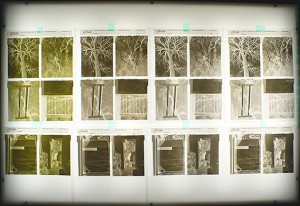
 There is one thing I can say beyond a doubt that I share with Ansel Adams. We share the same birthday, though he was near five decades before me. My only real regret when I think of Ansel is that I never met the man. But, every year I salute his birthday, maybe only because it is one thing we share. Happy Birthday Ansel!
 Never heard of Fred Picker? How about Zone VI Studios? If not, and if you are a serious practitioner of photographic art, I would suggest you learn about all of the aforementioned.